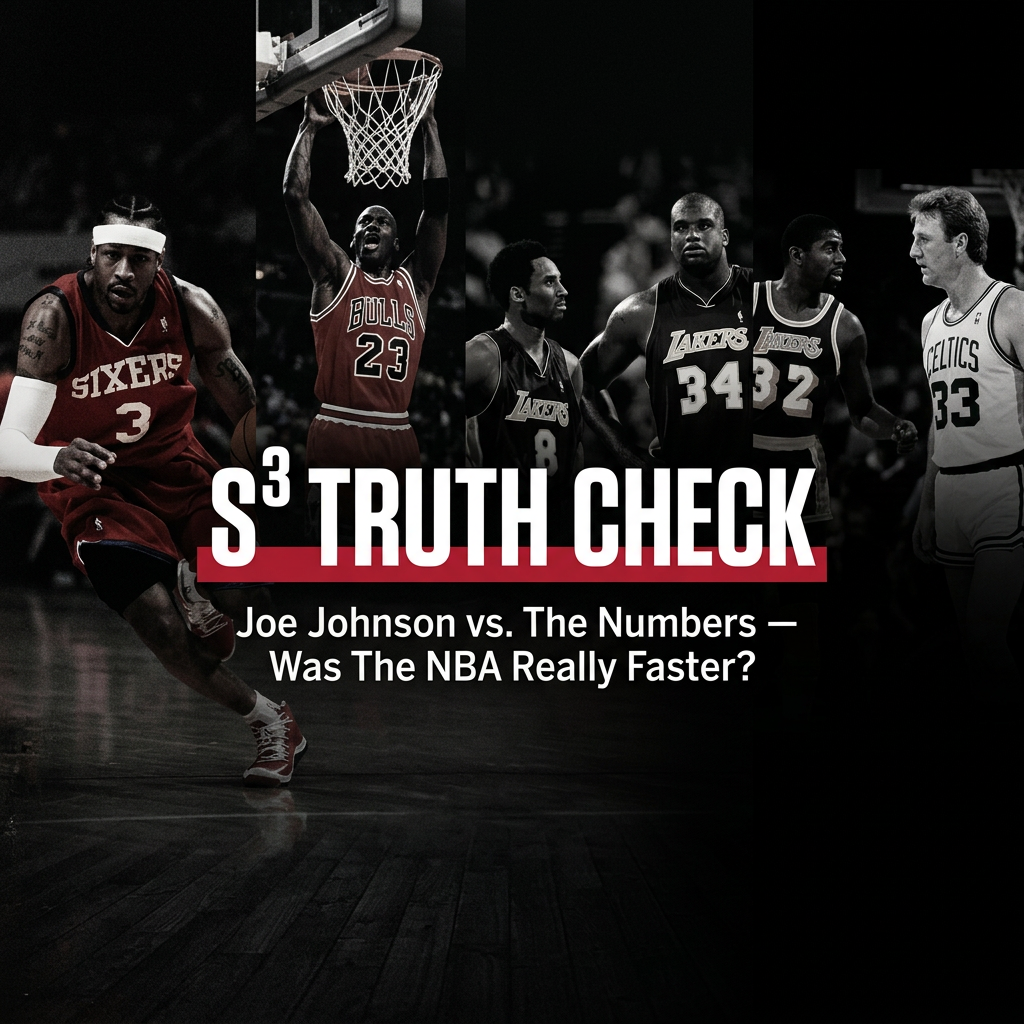

The Claim
When Joe Johnson says today's NBA is more frantic - more chaotic, faster, harder to process - he's speaking from feel. He's speaking from fourteen seasons of professional memory, from the muscle memory of a two-time All-Star who competed across three distinct eras of the sport.
But feel and fact are two different things. And when you actually run the numbers, the picture that emerges is more complicated - and more revealing - than Johnson's framing suggests.
This is what the data actually says.
Pace Doesn't Lie
In basketball analytics, pace has a precise definition: possessions per 48 minutes. It is the single most reliable measure of how fast a game is being played at the structural level. Not how it looks. Not how it feels. How many times the ball changes hands.
Here's what the historical record shows:
- 1970s: Up to 107+ possessions per game - routinely
- 1980s: Consistently at or above 100 possessions per game
- Today: Approximately 99-101 possessions per game
Let that sink in. The era with no three-point line, no modern spacing concepts, no load management - that era was running more possessions per game than the current NBA.
The modern game is not the fastest. It never has been.
Where Joe Johnson Gets It Mixed Up
This is where the conversation gets interesting - because Johnson isn't wrong about what he's seeing. The modern game genuinely looks faster. It feels more chaotic. There are real structural reasons for that perception.
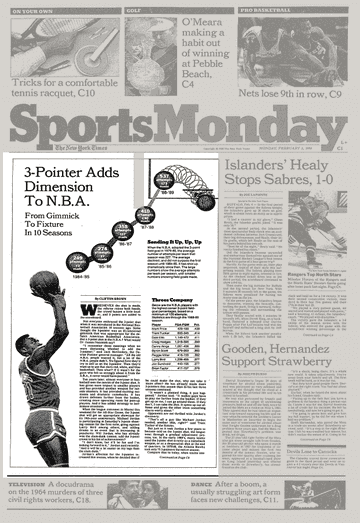
The league has never attempted more three-pointers. Teams are more spread out. Decision windows are shorter. Help rotations are more complex. The visual texture of a 2026 NBA game is dramatically different from a 1998 NBA game.
But here's the critical distinction: that's visual speed, not actual tempo.
More three-point attempts mean longer rebounds. Longer rebounds mean more open floor after misses. More open floor creates the sensation of a faster game. But when you count the possessions - the actual unit of pace - the numbers don't support the narrative.
The chaos is real. The acceleration is an illusion.
Allen Iverson's Point Actually Holds More Weight
This is the part of the conversation that often gets lost. When Allen Iverson called today's game soft, he wasn't making a pace argument. He was making a resistance argument - and that distinction matters enormously.
Iverson's claim is about the physical contract of the game, not the tempo of it. And on that front, the data is unambiguous:
- Contact rules have been dramatically liberalized in favor of offensive players
- Freedom of movement rules have fundamentally changed what defenders are permitted to do
- The hand-check era - the era that defined Iverson's career - is constitutionally illegal under today's rulebook
The game isn't faster than it used to be. But it is easier to operate in physically than at any point in NBA history. Iverson's discomfort with that reality is legitimate. His framing of it as weakness may be debatable. But the underlying observation is grounded in fact.
The Scoring Reality
If pace hasn't actually increased, how do we explain the modern scoring environment? The answer is layered - and it dismantles another common assumption.
- 1969-70: 116.7 points per game - with no three-point line
- 1980s: 108-110 points per game - with minimal three-point usage
- Today: Approximately 115 points per game - with historically high three-point volume
The modern era hasn't unlocked scoring because players are more skilled. It has unlocked scoring because of three interlocking factors: the residual pace from earlier eras, the rule changes creating offensive freedom, and the spatial revolution of the three-point shot.
In other words - the league is scoring at near-historic rates not because it's faster, but because it's been systematically engineered to produce more offense. That's a fundamentally different argument.
S³ Final Verdict
Joe Johnson isn't lying. He's not being dishonest or reckless. He's doing what most of us do - translating what he experienced through the lens of what he perceives. The game feels different. The rhythm has changed. The demands on decision-making are real.
But different is not the same as faster.
The modern NBA is not the fastest era in league history. The data on pace does not support that claim. Older eras matched or exceeded today's tempo without the spacing advantages, the floor-spread principles, or the offensive-friendly rulebook that defines 2026 basketball.
What changed wasn't the speed. What changed was the style. And if you're letting style be mistaken for substance - if you're letting visual chaos be mistaken for structural acceleration - then you're not reading the game. You're watching it.
The modern NBA didn't speed up. It just changed how speed looks.
And if you're going by the numbers - and at S³, we always go by the numbers - it is not faster than what came before.