
THE NUMBERS ARE BECOMING DIFFICULT TO DEFEND
Ashton Jeanty was selected sixth overall in the 2025 NFL Draft. When an organization invests that kind of draft capital in a running back, the expectation isn't average production. You're looking for a franchise-changing talent, a potential All-Pro and someone capable of delivering Hall of Fame-caliber impact.
Through 23 career games, Jeanty hasn't come close to establishing himself as that player.
His rookie campaign produced 975 rushing yards and five rushing touchdowns. Respectable numbers on the surface, but a closer examination reveals a different picture.
Jeanty needed 266 carries to accumulate those 975 yards, averaging just 3.7 yards per attempt and 57.4 rushing yards per game.
He added 346 receiving yards and five receiving touchdowns, finishing with 1,321 yards from scrimmage and 10 total touchdowns. Certainly not a disastrous rookie campaign, but was the overall production disguising an inefficient running back?
Six games into his sophomore season, that question is becoming increasingly relevant.
JEANTY BY THE NUMBERS
| Statistic | 2025 | 2026* |
|---|---|---|
| Games | 17 | 6 |
| Carries | 266 | 98 |
| Rushing Yards | 975 | 313 |
| Yards Per Carry | 3.7 | 3.2 |
| Rushing Yards/Game | 57.4 | 52.2 |
| Rushing TD | 5 | 1 |
2026 statistics through October 18.
Despite receiving slightly more carries per game, Jeanty's rushing production has declined.
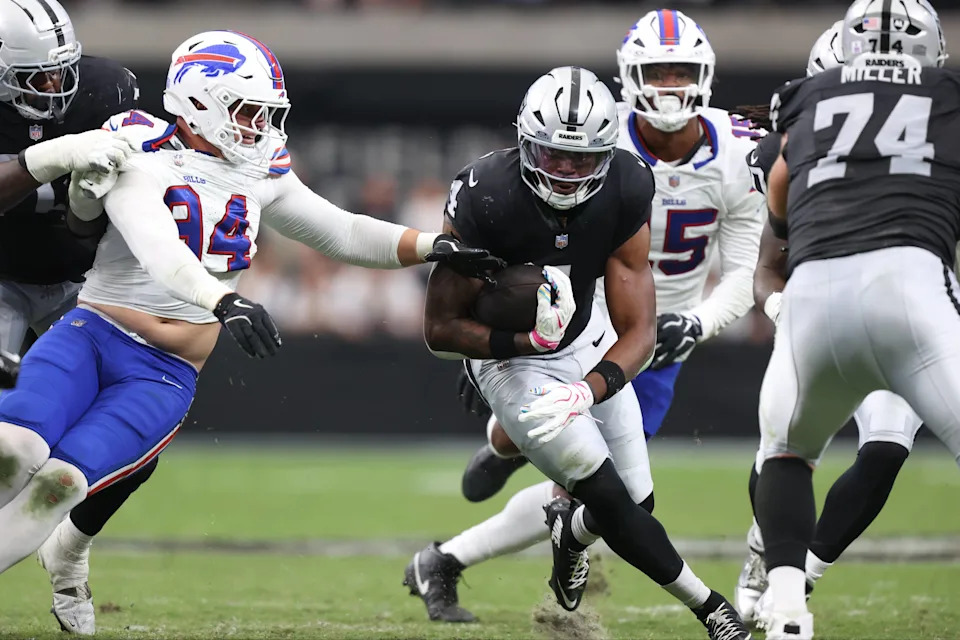
His latest performance against Buffalo produced just 22 yards on 10 attempts. Although he scored his first rushing touchdown of the season, the underlying concerns remain.
Since rushing for 102 yards in the season opener against Miami, Jeanty has managed only 211 yards on 75 carries.
That's 2.8 yards per attempt over five games.
THE PROBLEM BEHIND THE LINE OF SCRIMMAGE
The Raiders' offensive line has received considerable criticism, and some of it is warranted. But poor blocking shouldn't automatically excuse every unsuccessful rushing attempt.
Jeanty's running style deserves examination.
He utilizes a low center of gravity, short, choppy steps and considerable leg churn. Those characteristics can be effective, particularly when maintaining balance and running through contact.
The concern is what happens before he reaches the line of scrimmage.
From the S³ eye test, Jeanty appears to struggle at times with identifying developing running lanes. There are instances where he seems committed to the designed gap, even when another opening presents itself.
His footwork can become counterproductive when those short steps aren't accompanied by quick recognition and decisive acceleration.
Former Raiders offensive lineman Richie Incognito has raised similar concerns about Jeanty's vision, questioning his tendency to attack designated gaps regardless of the traffic developing in front of him.
This isn't simply a matter of foot speed.
It's about anticipation, improvisation and instinct.
An elite NFL running back must recognize when a play is breaking down and react accordingly. The designed hole is only the starting point. Defensive penetration, blocking leverage and developing cutback lanes determine where the football ultimately needs to go.
Some of those skills can improve through coaching and repetition, but exceptional running-back instincts are difficult to manufacture.
The playbook tells a running back where the hole is supposed to be. His instincts must tell him where the yards actually are.
THE BACKUP IS MAKING THINGS UNCOMFORTABLE
Perhaps the most revealing comparison isn't Jeanty against another highly drafted running back.
It's Jeanty against his own backup.
Through six games, Mike Washington Jr. has quietly produced some interesting numbers.
| 2026 Rushing | Jeanty | Washington Jr. |
|---|---|---|
| Carries | 98 | 34 |
| Rushing Yards | 313 | 168 |
| Yards Per Carry | 3.2 | 4.9 |
| Touchdowns | 1 | 1 |
Washington is averaging 1.7 additional yards per rushing attempt while operating within the same offensive system.
Granted, 34 attempts represent a considerably smaller sample, and differences in defensive personnel, formations and game situations must be considered.
Nevertheless, the disparity deserves attention.
If Washington continues producing efficiently, how long can Las Vegas justify its current distribution of carries?
This is no longer strictly a discussion about Jeanty's potential. It's becoming a discussion about production.
THE KLINT KUBIAK FACTOR
Jeanty may also find himself in an unfortunate organizational situation.
Klint Kubiak didn't draft him.
The new Raiders head coach inherited a running back selected sixth overall by the previous regime. While Jeanty's draft position represents a significant organizational investment, Kubiak's responsibility is to construct an offense capable of winning football games.
That means evaluating every player according to his system.
With a young quarterback to develop, Kubiak needs a running back who can identify running lanes, execute assignments, protect against defensive pressure and provide dependable production.
Pass protection, in particular, will be an important part of Jeanty's overall evaluation. Rushing statistics alone cannot determine which back provides the greatest value to the offense.
Washington's efficiency gives the coaching staff another option worth exploring.
And this Raiders team has pieces that suggest a competitive future isn't necessarily far away. Additional receiver talent, offensive-line improvements and a few calculated personnel decisions could significantly change its outlook.
The 2026 season is an opportunity for Kubiak to determine which players belong in that future.
Jeanty's draft position shouldn't exempt him from that evaluation.
IS JEANTY PLAYING FOR HIS FUTURE IN LAS VEGAS?
Following the Raiders' loss to New England, Athlon Sports published an October 11 article by Tyler Bischoff arguing that Las Vegas needed to sit Jeanty.
That's a remarkable conversation to be having about a running back selected sixth overall less than two seasons ago.
Injuries and offensive-line struggles deserve consideration. Jeanty has dealt with reported foot and ankle issues, and his supporting cast hasn't consistently provided favorable rushing conditions.
But those circumstances don't eliminate the responsibility to evaluate his individual performance.
Nor should anyone declare his NFL career a failure after 23 games.
Kenneth Walker III provides an example of a running back whose career experienced fluctuations before another productive resurgence. Nevertheless, Walker averaged 4.6 yards per carry as a rookie. His injury-shortened 2024 campaign, when he averaged 3.7, essentially matches Jeanty's rookie rushing efficiency.
The distinction matters.
For Jeanty, the question isn't whether he possesses NFL talent. It's whether he can develop the vision, anticipation and decisive running necessary to justify his original draft expectations.
A potential 2027 trade shouldn't be dismissed if his struggles continue, although such a decision would depend on considerably more than six games of production.
Kubiak has no obligation to build his future offense around yesterday's draft position.
Jeanty must give him a reason to believe.
THE S³ FINAL WORD
Ashton Jeanty wasn't drafted sixth overall to become another serviceable running back. He was selected to become a difference-maker.
Through six games in 2026, his backup is outperforming him in rushing efficiency, questions surrounding his vision are growing, and a new coaching staff is determining the direction of the franchise.
There is still time for Jeanty to reverse the narrative.
But the clock is ticking.
A running back who creates yards when nothing is there is special. A running back who consistently misses yards when something is there has a problem.
And for Ashton Jeanty, the problem may be bigger than the offensive line.
Sweet Science Sports | S³ NFL