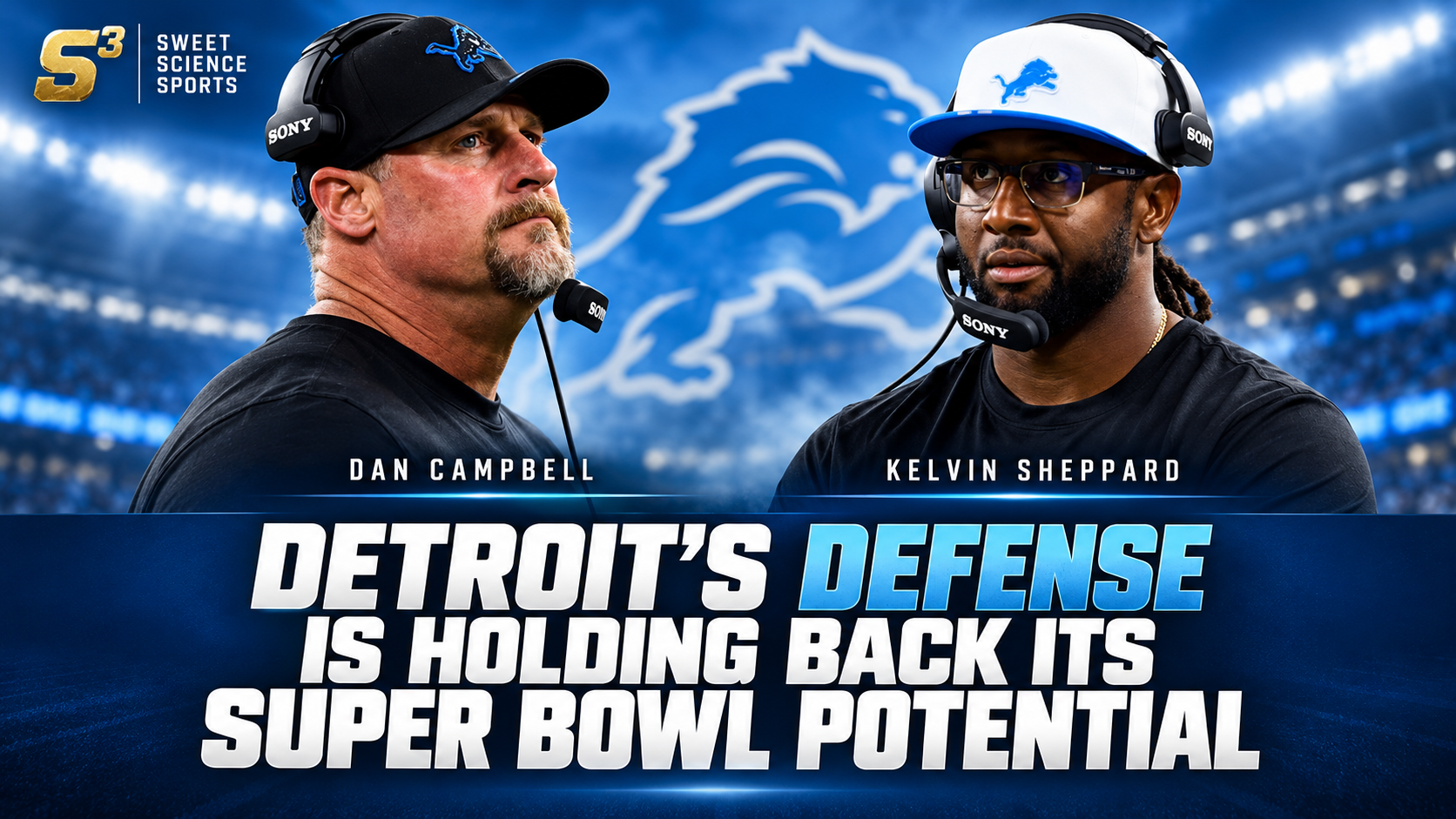

Dan Campbell changed the football culture in Detroit. The Lions have posted four consecutive winning seasons under his leadership, including a franchise-record 15 wins in 2024. He established a team defined by confidence, toughness and rising expectations.
Those expectations now include competing for a Super Bowl. Detroit has the offensive core to support that ambition. Its defense, nevertheless, is limiting how far the team can go.
In the S³ assessment, Jared Goff belongs among the NFL’s top 10 quarterbacks. Jahmyr Gibbs has a strong case as a top-three to top-five running back. Amon-Ra St. Brown is a top-10 receiver with a credible argument for the top five, while Sam LaPorta belongs in the top-10 tight end conversation.
That is a formidable collection of talent. Gibbs provides an explosive threat as both a runner and receiver. St. Brown gives Goff a dependable primary target, and LaPorta creates another difficult matchup. Detroit has several ways to move the ball and put pressure on opponents.
The defense must start doing its part.
An Offense Carrying Too Much of the Burden
Through four games of defensive coordinator Kelvin Sheppard’s second season, Detroit is 2–2 and has allowed a league-high 127 points, an average of 31.8 per game. The Lions also rank last in total defense at 423.8 yards allowed per game and last in net passing yards allowed at 304.0. Opponents have scored at least 30 points in three of those four contests.
Sunday night’s 32–26 loss to Carolina exposed the problem again. The Panthers gained 445 total yards, while Tetairoa McMillan caught 14 passes for 192 yards and two touchdowns. Detroit produced 452 yards of offense and still lost.
Offensive execution matters, including Detroit’s missed opportunities late against Carolina. But repeatedly asking the offense to overcome 30-point allowances leaves too little room for error. Even an elite offense will have stalled drives, turnovers and difficult quarters.
A contender needs a defense that can protect a lead and deliver a critical stop.
A Persistent Defensive Concern
Detroit’s defensive record under Campbell shows why the concern extends beyond one difficult night:
| Season | Points allowed per game | NFL scoring rank |
|---|---|---|
| 2021 | 27.5 | 31st |
| 2022 | 25.1 | 28th |
| 2023 | 23.2 | 23rd |
| 2024 | 20.1 | 7th |
| 2025 | 24.3 | 22nd |
| 2026, through four games | 31.8 | 32nd |
Regular-season figures. The 2021–25 rows cover completed seasons; 2026 covers the first four games.
The rebuilding years deserve context, and 2024 deserves credit. That defense finished seventh in scoring, first on third down and second on fourth down despite significant injuries. Detroit demonstrated that it could field an effective unit.
The subsequent regression is what makes the current situation troubling. The Lions fell from 15–2 in 2024 to 9–8 in 2025, while their scoring defense dropped to 22nd. The early 2026 results have pushed those defensive numbers further in the wrong direction.
There is production up front. Aidan Hutchinson has 3.5 sacks, while Alim McNeill and D.J. Wonnum have three each. Detroit has 15 sacks as a team.
That pressure has not translated into enough dependable stops.
Injuries Matter, but So Does Accountability
Injuries have complicated the work. Brian Branch could return to practice pending medical clearance. Rock Ya-Sin suffered a hamstring injury against Carolina, and Tyleik Williams is day to day.
Their availability matters. The staff must nevertheless improve the performance of the players available now.
Campbell’s reputation centers on toughness and physical football. His coaching background is offensive: he played tight end, coached the position in Miami and served as New Orleans’ assistant head coach and tight ends coach before taking over in Detroit.
As head coach, his responsibility extends to the entire team.
In the S³ view, Sheppard should be on the hot seat because of his unit’s performance. Campbell should also face growing pressure over Detroit’s championship progress. Sheppard is responsible for the defensive plan, but Campbell selects the staff and shares responsibility for a weakness that predates Sheppard’s promotion.
Campbell has emphasized adjustments to defensive calls, personnel and execution, along with better discipline across all three phases. Those changes must produce visible improvement.
S³ Verdict
Detroit still has time to correct its course. Its offensive talent gives it a foundation for a serious championship challenge.
But potential is not the same as readiness.
To turn its Super Bowl ambition into a credible run, Detroit needs cleaner coverage, fewer breakdowns and a defense capable of finishing close games. The offense cannot be expected to carry the team every week.