
Editor's Note: With the 2026 NFL Draft upon us, S³ takes you behind the closed doors of one of the most secretive operations in professional sports.
The Room Where It Happens
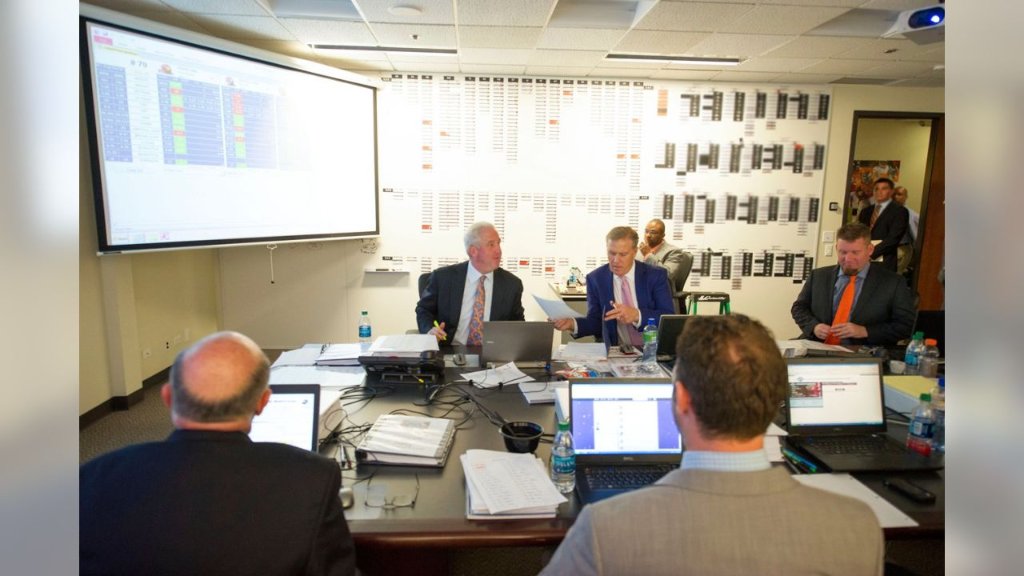
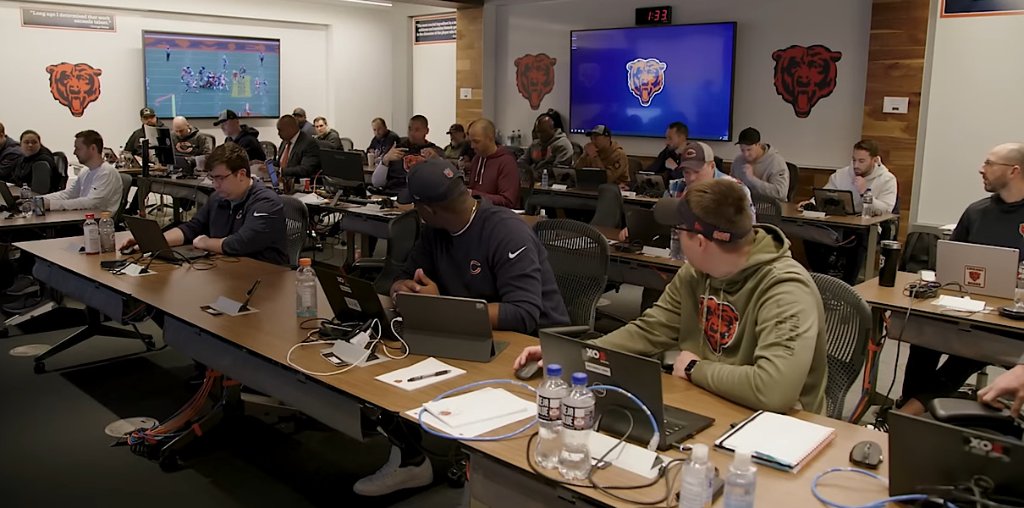
No windows. No outside noise. A keycard on the door, a countdown clock on the wall, and a room full of people who understand exactly what's riding on the next three days.
I'll be honest with you - the NFL Draft war room gets romanticized a lot. People imagine some cinematic command center humming with genius. The reality is both less glamorous and more intense than that. It's a sealed room built for one purpose: make the best possible decision in the least possible time, then do it again. And again. For three straight days. What happens inside those walls can define a franchise for the next decade. What happens outside barely registers.
This is where championships get built. It's also where they quietly fall apart before a single snap is ever played.
The Chain of Command
Every room has its own feel. Every organization runs it a little differently. But the hierarchy at the top? Almost always the same.
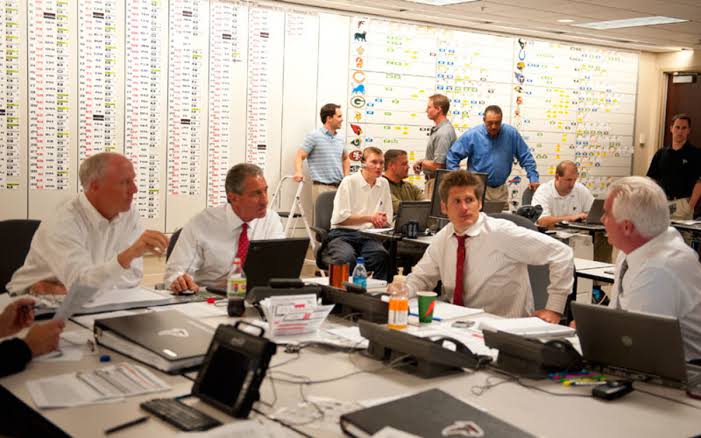
The GM sits at the center - not always the loudest voice in the room, but always the last one. Everything flows toward him and through him. The head coach is right there beside him, because the decisions made in April have to survive September. And depending on the franchise, the owner's in there too, which is either reassuring or terrifying depending on the owner.
Around them you've got cap experts running dead money calculations in real time, analysts working proprietary models built to find value where everyone else sees noise, and team doctors who know that a player's body can matter just as much as his film. These aren't ceremonial seats. On draft night, every single one of them earns their spot - or doesn't.
The Scouts: In the Room or On the Line
Ask ten GMs how they deploy their scouts on draft night and you'll get ten different answers. That's not a coincidence. That's philosophy.
Some organizations keep their regional scouts right there in the war room, every voice under one roof. Others station them separately, on call when a specific question needs a specific answer fast. The logic behind the second approach isn't complicated: too many voices in a high-pressure environment creates chaos, and chaos costs picks. I've seen it happen. It's not pretty.
But here's the thing - when a name comes off the board unexpectedly, when a player who had no business being available at this spot suddenly is, the regional scout who spent three days in November watching that kid practice in the cold becomes the most important person on the line. That call happens in seconds. The clock doesn't pause for anyone to get their thoughts together.
The Card Man
One role. Almost never talked about. Absolutely essential.
Every team has a dedicated rep physically stationed at the draft site - on an open line with the war room, ready to walk a small card to the podium the second the call comes in. Sounds like the simplest job in the building. It's also the most unforgiving. Miss the clock and the pick is forfeited. Not delayed. Not penalized. Gone. The pick that could've changed everything, gone - because a card didn't make it in time.
Nobody remembers the card man when it goes right. Everybody remembers when it goes wrong.
The Boards Don't Lie
The magnetic boards are gone. The hand-written index cards are gone. What replaced them looks more like mission control than a football operation.
Floor-to-ceiling video walls display every player still available - organized by position, ranked overall, updated the instant a name is called anywhere in the league. A pick goes in across the room and that player vanishes in real time. Conversations shift. The board recalibrates. The room recalibrates with it.
Multi-screen arrays feed live broadcast coverage, prospect data, trade negotiations, and the draft clock simultaneously. Nothing gets missed. Nothing is allowed to get missed.
And at the center of all of it sits the vertical board - the master ranking. The list that tells a GM, regardless of need, regardless of position, regardless of what the fanbase is losing its mind about on social media: this is the best player still available. The best teams follow it. The teams in chaos abandon it. You can usually tell which is which by October.

The Algorithm in the Room
Analytics aren't coming to the war room. They've been there for years. That debate is over.
Every major franchise now runs proprietary models that crunch film grades, athletic testing, injury history, contract projections, and historical comp data all at once. Some teams have built systems that can spit out a trade value recommendation before the GM has even finished processing the offer on the phone. The machine moves faster than the conversation. Sometimes faster than human judgment can keep up with.
But here's where it gets complicated - and I mean genuinely complicated, not TV-drama complicated. The model gives you a number. The scout gives you a feeling. The coach gives you a preference. And the GM has to decide which one he trusts when it's third-and-forever in a game that actually matters. That tension between data and instinct is the real drama of the modern war room. It doesn't always resolve cleanly. Anybody who tells you it does is selling something.
The smartest organizations use analytics as a check on bias, not a replacement for judgment. The ones who haven't figured that out are still wondering why their model keeps producing players who look great on paper and disappear in real games.
The Trade Phone
It never stops ringing. Or rather - the people who need it to ring make sure it doesn't stop.
The moment a team goes on the clock, its draft board becomes everyone else's leverage point. Other GMs are working the phones, testing what it costs to move up, move down, or get out of a position entirely. This is where months of preparation either holds or falls apart in about four minutes. A team that walks in already knowing its move-up threshold for a specific player can act in seconds. A team having that conversation in real time, while the clock runs, is already losing. I don't care how talented their roster is.
Look, the best GMs treat the trade market like live intelligence - every call tells them as much about what other teams value as it does about their own roster. What someone's willing to give up reveals exactly how badly they need something. That's information. That's leverage. The sharp operators use both, and they've usually already gamed out three versions of the conversation before the phone rings.
The Human Factor
For all the technology, all the preparation, all the process - the draft still comes down to people in a room making calls that no model can fully account for.
Character evaluations. Medical red flags that look worse on paper than they do in person. A coach's relationship with a position coach at a prospect's college. The GM who flew out to watch a kid work out one more time and came back with a different read than the one he left with. These are the variables that live outside the spreadsheet, and they matter more than most front offices will ever publicly admit - because admitting it means admitting the limits of the system they spent millions building.
The best war rooms hold both things at once. Respect the data. Trust the process. And still leave room for the human read that changes everything. That balance takes years to build. It takes one bad draft - sometimes one bad pick - to lose it.
S³ Bottom Line
The war room is where franchises show you who they actually are. Not in press conferences. Not in splashy offseason acquisitions. In there - when the clock is running, the board is shifting, and someone has to make a call that could define the next five years of this organization.
The teams that get it right have built a room that functions: clear hierarchy, trusted process, smart use of technology, and the discipline to stay on the board even when the noise outside is deafening. The teams that get it wrong usually knew they were getting it wrong. They just couldn't stop themselves. That part never changes, no matter how much the technology does.
Every pick that ever changed a franchise started exactly here. This is the work that happens before the work. Don't sleep on it.