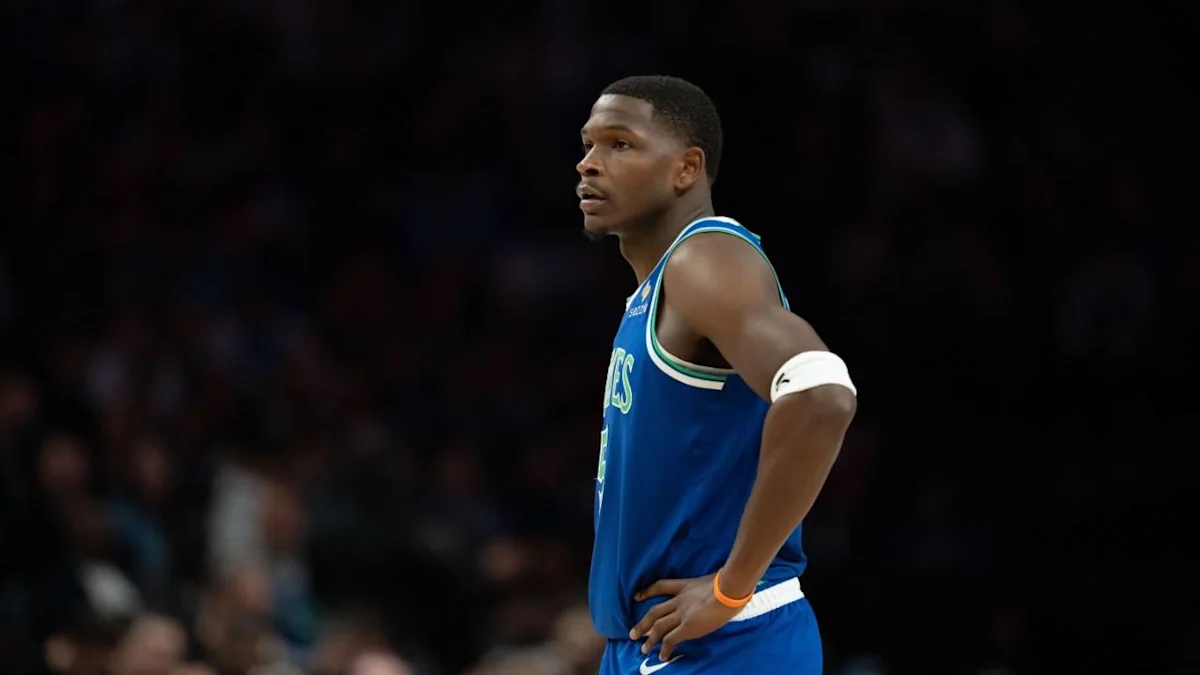

Minnesota's franchise player faces an extended absence after years of knee concerns, leaving the Timberwolves with difficult questions about injury management and their championship aspirations.
The Minnesota Timberwolves entered the 2026–27 NBA season with championship expectations. Just four games into the season, those expectations have encountered a major obstacle.
Anthony Edwards, Minnesota's franchise player and the S³ preseason MVP selection, is reportedly scheduled to undergo arthroscopic surgery on his right knee, potentially sidelining him for approximately two months.
The injury itself is concerning. The history behind it raises an even bigger question.
Why wasn't Edwards' recurring knee problem addressed during the offseason?
The Warning Signs Were Already There
Edwards' knee problems didn't begin this October.
During the 2025–26 season, Edwards appeared in just 61 games, with knee issues contributing to his absences. An April injury report specifically identified right-knee patellofemoral pain syndrome, commonly known as runner's knee.
Minnesota entered the offseason knowing its most important player had experienced recurring knee discomfort.
According to reports, Edwards rested his knees during the summer and entered training camp feeling healthy. That apparently gave Minnesota reason to believe the issue could be managed without surgery.
But feeling healthy and resolving an underlying medical problem are not necessarily the same thing.
Edwards reportedly aggravated his right knee after the season began. Now, instead of preparing for the heart of the regular-season schedule, Minnesota is preparing to play an extended stretch without its best player.
That sequence deserves scrutiny.
Was Surgery Necessary During the Offseason?
There is an important medical distinction that cannot be ignored.
Not every recurring knee problem requires surgery. Rest, rehabilitation, strengthening and workload management are legitimate treatment options. Surgery also carries risks, and undergoing an operation without a clear medical indication would not necessarily have been the correct decision.
The unanswered question is whether Minnesota had enough information during the offseason to anticipate the current problem.
Was structural damage visible? Did doctors recommend continuing conservative treatment? Did the condition worsen only after Edwards returned to competitive basketball?
Those answers matter.
The Timberwolves should not be criticized simply because an injury returned. But when a franchise player experiences knee problems across consecutive seasons and eventually requires surgery shortly after opening night, examining the decision-making process is reasonable.
Minnesota's Championship Plans Take a Hit
Edwards was expected to lead a Minnesota team capable of challenging the Oklahoma City Thunder and the other Western Conference contenders.
His importance extends beyond scoring.
Edwards commands defensive attention, creates opportunities for teammates and gives Minnesota a dependable offensive option when possessions break down.
The Timberwolves have additional offensive talent, including LaMelo Ball, but replacing Edwards requires more than finding another player to score 25 or 30 points.
His absence changes defensive matchups, late-game execution and the overall structure of Minnesota's offense.
For a team with championship aspirations, losing its primary offensive weapon for an extended period can affect playoff positioning before the season reaches its midpoint.
The MVP Race and Financial Consequences
Edwards' absence also threatens his eligibility for major individual honors.
Under the NBA's 65-game participation requirement, missing approximately 25 games would ordinarily prevent him from qualifying for MVP and All-NBA consideration, subject to the league's applicable exceptions.
That carries additional significance because certain contract opportunities, including designated veteran supermax eligibility, can depend on qualifying individual achievements.
Reports have connected Edwards' potential future extension to a figure around $304 million.
But missing this season's awards would not automatically eliminate every possible route to such a contract. His eligibility would depend on the relevant collective bargaining agreement requirements, his prior honors and the timing of a potential extension.
For Edwards, the financial stakes make an already frustrating injury situation even more consequential.
The Return Timeline Remains Uncertain
Initial reports suggested Edwards could miss approximately two months, while subsequent reporting raised the possibility of a January return.
An earlier comeback remains possible depending on the nature of the surgical procedure and his recovery.
The most important development will be the medical evaluation following surgery.
Minnesota must resist the temptation to rush its franchise player back simply to preserve regular-season positioning or individual award eligibility.
At 25 years old, Edwards' long-term health should carry more weight than any single stretch of games.
S³ Analysis: The Question Minnesota Must Answer
Injuries are part of professional sports. Even the best medical staffs cannot prevent every setback.
But recurring injuries demand careful evaluation, especially when they involve a franchise player carrying championship expectations.
Anthony Edwards had knee problems last season. He rested during the offseason. He returned to competition. Now he reportedly needs surgery.
That timeline does not prove Minnesota mishandled his condition.
It does establish why questions about the offseason treatment plan are legitimate.
If the medical evidence supported rehabilitation rather than surgery, Minnesota may have made a reasonable decision that ultimately failed to produce the desired outcome.
If the current surgical problem was already identifiable during the offseason, the organization will face a more difficult question about whether the risks were adequately assessed.
For now, the Timberwolves must navigate the Western Conference without their most important player, while Edwards faces uncertainty surrounding his health, individual honors and potential contract opportunities.
Minnesota's immediate challenge is surviving without Anthony Edwards. Its larger challenge is understanding why a recurring knee problem has become a major obstacle so early in a championship-contending season.
S³ | Where Intelligence Meets Impact.