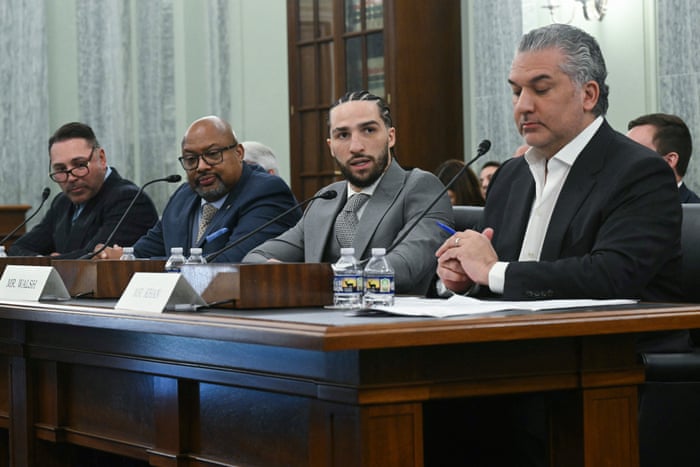
The hearing room on April 22 said everything about where boxing stands right now - divided, territorial, and fighting over its own soul.
The Muhammad Ali American Boxing Revival Act of 2026 (H.R. 4624) passed the U.S. House of Representatives on March 24 via voice vote. It now sits before the Senate Committee on Commerce, Science, and Transportation. And if the hearing last Tuesday was any indication, the road from the House to a Senate signature is going to be anything but smooth.
What the Bill Proposes
The centerpiece of H.R. 4624 is the creation of Unified Boxing Organizations (UBOs) - entities that would be permitted to oversee promotion, rankings, and sanctioning under one roof. Think of it as applying the UFC's centralized model to professional boxing.
Beyond structure, the bill does address real, long-standing problems in the sport:
- Fighter pay minimums: A national floor of $200 per round for professional fighters
- Health insurance: At least $50,000 in coverage for bout-related injuries
- Medical standards: Annual physicals mandated - including brain, eye, and heart exams
- On-site safety: Two ambulances required at every professional fight
On paper, some of these provisions are genuinely overdue. Fighters have gone too long without consistent safety floors. The question isn't whether boxing needs reform. It's whether this bill is actually the reform boxing needs.
The Hearing: A Sport at War With Itself
The April 22 Senate hearing drew sharp testimony from across the industry - and it became clear almost immediately that the sport's most powerful voices are not reading from the same script.
In favor: Nick Khan, Dana White, and Mike Tyson. Their argument is straightforward - UBOs bring structure to a fractured ecosystem, create financial stability for fighters, and establish consistent safety standards across jurisdictions that currently operate on wildly different rules. White, who built the UFC into a global brand under exactly this kind of centralized model, called the bill a necessary evolution.
In opposition: Oscar De La Hoya, Nico Ali Walsh, and Bob Arum. Their concern isn't reform - it's who controls the reform. De La Hoya and Arum, both promoters with decades of experience, argue that allowing a single entity to handle promotion and sanctioning and rankings recreates the exact monopolistic conditions the original Muhammad Ali Boxing Reform Act was designed to prevent. That law, signed in 1996, was built on a foundational principle: keep promoters and sanctioning bodies separate to protect fighters from exploitation.
Nico Ali Walsh, Muhammad Ali's grandson and a professional fighter himself, went further than anyone in the room. He stated plainly that this legislation should not carry his grandfather's name if it weakens that core principle. That's not rhetoric. That's a direct challenge to the bill's moral framing.
It's worth noting that Lonnie Ali, Muhammad Ali's widow, has voiced support for the changes - believing centralization could help restore boxing's relevance in the American sports landscape. That divide within the Ali family reflects just how genuinely complicated this conversation is.
What's Actually at Stake
This goes beyond policy. This is a fight over boxing's identity - and the tension between modernization and exploitation runs directly through it.
The proponents aren't wrong that boxing is fragmented. Multiple sanctioning bodies, inconsistent state athletic commission oversight, fighters getting outmaneuvered in contract negotiations - these are real problems that have real consequences for real athletes. The sport has been losing ground to MMA for twenty years, and part of that is because the UFC can build stars in a way that boxing, with its promotional chaos, simply cannot.
But the opponents aren't wrong either. The original Ali Act exists because boxing's history is filled with fighters who were controlled, exploited, and discarded by the very promotional systems that were supposed to serve them. Giving one organization the power to promote, rank, and sanction at the same time isn't modernization. It's consolidation. And in boxing, consolidation has almost always meant fewer options and less leverage for the athletes at the center of it all.
Once fighter leverage disappears - and it can disappear fast - the entire ecosystem shifts. Purse splits get worse. Contract terms get longer. Managers and trainers lose their ability to negotiate from a position of strength. That's not speculation. That's history.
The S³ Bottom Line
H.R. 4624 is heading to the Senate with real momentum and real opposition. The fighter protection provisions - the $200-per-round minimums, the health insurance requirements, the medical mandates - those deserve to survive whatever version of this bill eventually passes. They're long overdue.
The UBO structure is the problem. Not because centralization is inherently wrong, but because boxing has never had a governing body powerful enough to actually hold a centralized entity accountable. Without that check, you're not fixing the sport. You're just changing who's in charge of the exploitation.
Nico Ali Walsh said it best. If this law is going to carry Muhammad Ali's name, it needs to be worthy of it.