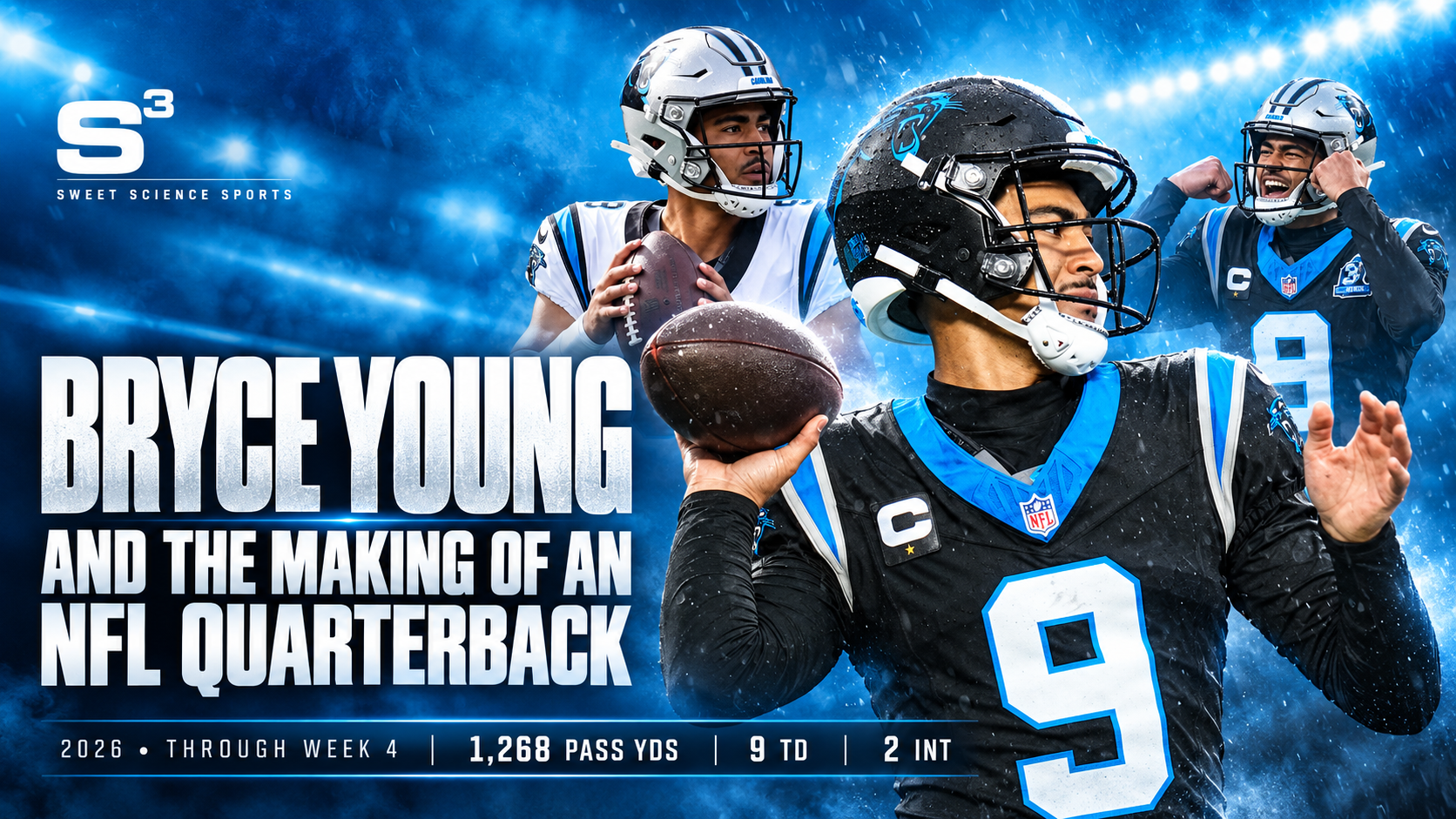

Bryce Young had to fight through the storm to reach nights like this.
Against Detroit, he completed 29 of 41 passes for 329 yards, two touchdowns and no interceptions, leading Carolina to a 32–26 victory. Tetairoa McMillan caught 14 passes for 192 yards and both passing touchdowns. Chuba Hubbard added 122 rushing yards and two scores.
Young delivered despite an offensive line missing both regular starting tackles, losing Damien Lewis before kickoff and losing its replacement right tackle during the game. Carolina improved to 2–2, and its quarterback gave another reason to examine his development beyond the struggles that defined his beginning.
Through four games, Young has completed 101 of 162 passes for 1,268 yards, nine touchdowns and two interceptions. He is averaging 317 passing yards per game with a 62.3% completion rate.
His production deserves a place in the early MVP conversation. Sustaining it and leading Carolina to more victories would strengthen that case. But the bigger story is how a young quarterback learns to produce at this level.
Learning the Position at NFL Speed
A quarterback has only a few seconds after the snap to turn preparation into execution. He must understand his receivers’ routes, his running back’s responsibilities, the protection and the defensive coverage. Before the snap, he may need to change the play or adjust the protection.
Then the defense can change the picture.
Now he must recognize the coverage, anticipate the opening, feel pressure and deliver on time. A receiver may still be approaching his break when the ball needs to leave the quarterback’s hand.
Knowing the assignment is one step. Executing it consistently against NFL speed takes repetition. Experience gives a quarterback more situations to recognize and more mistakes to learn from.
Young’s path has included that education through live game action, but it also included time on the bench.
After Carolina opened 2024 with two losses, Dave Canales replaced Young with veteran Andy Dalton. The change was announced on September 16, ahead of Week 3. Young returned to the starting lineup for Week 8 at Denver after Dalton injured his right thumb in a car accident.
That matters to this story. Young experienced the demands of starting, the setback of losing the job and another opportunity to apply what he had learned. His development combined game experience with a period behind a veteran. Patience can include changing a player’s role while continuing to develop him.
The Manning Lesson
Peyton Manning threw 26 touchdowns and 28 interceptions as a rookie in 1998. Indianapolis kept him on the field, and he took every offensive snap that regular season.
Those interceptions became part of his development. Even a quarterback who would become one of the game’s greats had to learn what NFL defenders could disguise, how quickly passing windows could close and which decisions he could trust.
Young does not need to become Manning for the comparison to matter. The lesson is that early mistakes alone cannot tell you a quarterback’s eventual ceiling. How he responds to them matters.
Drew Brees has offered a similar perspective, suggesting roughly 50 high-level starts across college and the NFL as a useful guideline for understanding a young quarterback. That is his framework, rather than a universal deadline.
Brees also describes quarterbacking as an art form built around rhythm and repeatedly making sound decisions. That helps explain why arm strength and athletic ability are only part of the evaluation.
Different Quarterbacks, Different Paths
The Raiders offer another approach with Fernando Mendoza.
At 3–1, Las Vegas already looks like a team building a working foundation. Kirk Cousins handles the games while Mendoza learns behind a veteran familiar with Klint Kubiak’s offense. Kubiak has expressed a preference for giving a rookie that opportunity to learn before starting.
The potential benefit is clear: Mendoza can study preparation and decision-making while the team establishes its system around him.
Young’s education has included playing, struggling, being benched and returning to apply the lessons. Mendoza is getting an opportunity to prepare behind a veteran before taking on the same responsibility.
Some quarterbacks benefit from immediate game experience. Others benefit from more preparation behind a veteran. Both still need coaching, meaningful repetitions and support.
The S³ View
I believe Young’s performance against Detroit supports the case for patience. He produced efficiently despite the injuries around him, protected the football and helped his team win.
His season completion percentage remains below last year’s 63.6%, so the improvement is not uniform across every category. But nine touchdowns against two interceptions is encouraging evidence of productive quarterback play.
One strong night does not finish the development process. It gives us something concrete to evaluate.
Young has fought through the storm. Now the challenge is to keep repeating the decisions that brought him through it.
Reference links: Young’s 2024 benching; Young’s return at Denver; Manning’s 1998 statistics; Colts’ 1998 season review; Brees on quarterback experience; Brees’s Hall of Fame speech; Kubiak’s development approach.