
Aaron Rodgers has long been regarded as one of the most gifted passers in NFL history. His lightning-fast release, pinpoint accuracy, and effortless ability to drive the football downfield have made him one of the league’s premier quarterbacks.
At the center of his throwing motion is a signature wrist flick, a refined biomechanical technique that helps him generate outstanding velocity, tight spiral rotation, and elite accuracy while releasing the football in a fraction of a second.
Rodgers’ throwing motion was not created overnight. It evolved through years of coaching, experimentation, and adaptation, transforming from a mechanically rigid delivery into one of the most efficient and versatile motions the game has seen.
The Early Years
Rodgers’ mechanics looked much different early in his football career.
At Pleasant Valley High School, the future MVP stood just 5-foot-10 and weighed around 165 pounds. Although flashes of the famous wrist flick were already visible, his mechanics were still raw and inconsistent. Even so, he set numerous school passing records and displayed the natural arm talent that would later define his career.
His time at Butte Community College focused largely on building arm strength and refining his fundamentals, but his delivery still lacked the polish that would come later.
Everything changed at the University of California under head coach Jeff Tedford. Rodgers developed a compact, technically sound throwing motion built around a high release point and disciplined mechanics. While the system improved his precision, many scouts believed it made him appear overly robotic and limited his ability to improvise.
Those perceptions followed him into the 2005 NFL Draft, where some evaluators questioned whether he was simply a “system quarterback.”
Brett Favre’s Influence
After arriving in Green Bay, Rodgers found the perfect model in Brett Favre.
Favre’s style could not have been more different. He relied on instinct, creativity, and unconventional throwing angles to make plays from nearly any platform. Rodgers absorbed those lessons while maintaining his own disciplined approach.
Favre’s influence helped Rodgers develop:
- A quicker, more compact release.
- The ability to throw accurately from multiple arm angles.
- Confidence making off-platform throws.
- Greater creativity when extending plays outside the pocket.
Rather than copying Favre, Rodgers blended Favre’s improvisational style with his own technical precision, creating a throwing motion that became uniquely his.
Mike McCarthy’s Refinements
Rodgers’ development accelerated under head coach Mike McCarthy.
During an intensive two-week quarterback camp featuring six-hour daily sessions, McCarthy focused on eliminating wasted movement while maximizing efficiency. The emphasis shifted from throwing primarily with the arm to generating power from the ground up.
Rodgers learned to:
- Drive throws using his hips and core.
- Keep his motion compact and repeatable.
- Reduce unnecessary arm strain.
- Increase release speed without sacrificing velocity.
Those refinements helped shape the wrist flick into one of the fastest and most efficient releases in football.
Breaking Down the Wrist Flick
Pre-Throw Position
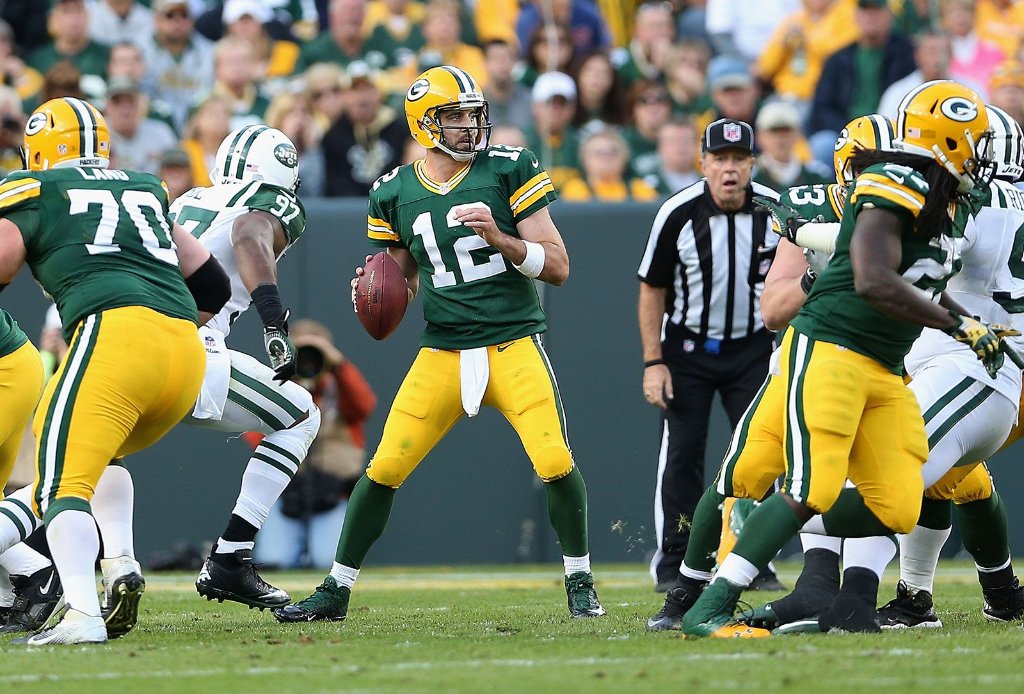
The football is held in a relaxed, compact position near the ear, with the elbow just below shoulder level. This setup minimizes wasted motion before the throw begins.
Separation
As Rodgers begins his delivery, the ball briefly loads just behind the ear. The movement is short, controlled, and efficient, allowing for an exceptionally quick release.
Hip Rotation
Power starts from the ground.
Rodgers rotates his hips after the lead foot plants, creating a powerful kinetic chain through the lower body. His front toe stays aligned with the target while the front knee remains closed until rotation begins.
Extension
As the hips fire, the arm accelerates through the throwing window. The palm turns downward at release, and the signature wrist flick produces a tight spiral, increased spin, and excellent trajectory control.
The Pop Foot
One of the subtler parts of Rodgers’ mechanics is the pop foot.
As the ball leaves his hand, he naturally pops off the ground, allowing energy to transfer smoothly through the throw. This small movement helps maximize balance, timing, and overall efficiency.
Why It Works
Rodgers’ throwing motion succeeds because every movement serves a purpose.
His lower body generates power. His upper body stays compact. His wrist provides the final burst of speed and spin.
The result is a delivery that is both explosive and remarkably efficient, allowing him to make every throw on the field while placing less unnecessary stress on his arm.
Lessons for Quarterbacks
Rodgers’ mechanics offer valuable lessons for quarterbacks at every level.
His success demonstrates that elite arm talent is only part of the equation. Efficient footwork, proper hip rotation, a compact release, and disciplined fundamentals allow quarterbacks to throw with both power and consistency.
Just as important, Rodgers proved that great mechanics do not limit creativity. They enhance it.
Final Thoughts
Aaron Rodgers’ throwing motion represents a rare blend of biomechanics and improvisation.
His journey from a mechanically rigid college passer to one of the NFL’s most creative and efficient quarterbacks was shaped by years of refinement, Brett Favre’s influence, and Mike McCarthy’s emphasis on efficiency.
The signature wrist flick has become more than a recognizable motion. It is a blueprint for maximizing release speed, accuracy, velocity, and longevity.
For quarterbacks looking to elevate their game, Rodgers’ evolution offers a clear lesson: master the fundamentals, eliminate wasted movement, and never lose the ability to create when the play breaks down.