
Hall Of The Sweet Scientist
Pierce Egan
“The Plutarch of the Ring” · Inductee No. 003
First Contributor Inductee · Sweet Science Sports (S³)
Biography
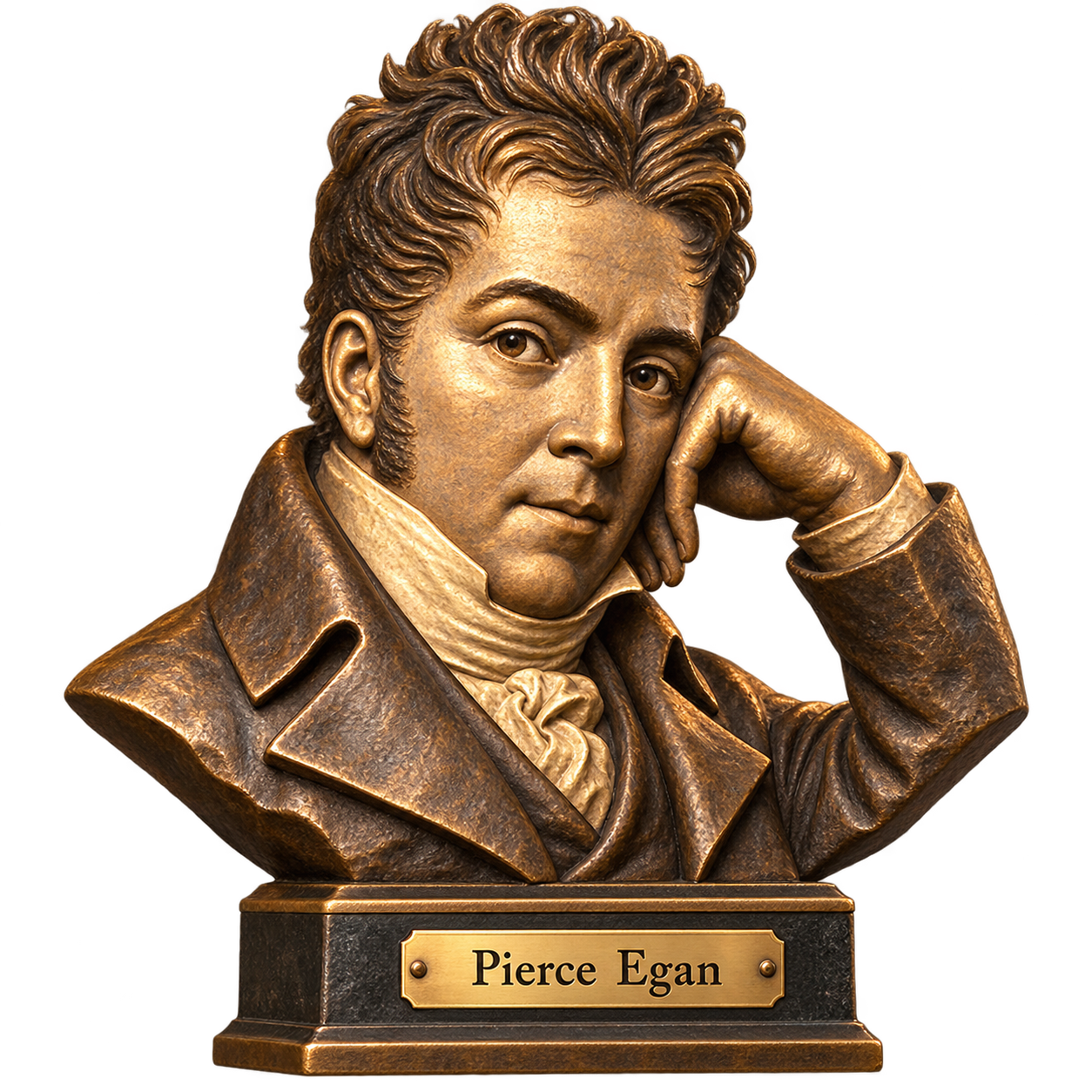
Pierce Egan (1772–1849) was a pioneering British journalist, sportswriter and chronicler of popular culture. Trained in the printing trade, he became one of the defining voices of the bare-knuckle boxing era. His writing preserved the fighters, contests and personalities of a sport whose history depended heavily on eyewitness reports and the printed word.
His landmark series, Boxiana; or, Sketches of Ancient and Modern Pugilism, combined fighter biographies with detailed accounts of their battles. Its lively prose helped establish boxing writing as a recognizable literary form. The Irish poet Thomas Moore called him “the Plutarch of the ring,” comparing his portraits of fighters to the classical biographer’s accounts of notable lives.
S³ welcomes Egan as the Hall’s third inductee and its first contributor, following Jack Johnson and Muhammad Ali.
Contributor profile
- Induction category
- Contributor: Boxing Journalism and History
- Born
- 1772
- Died
- August 3, 1849
- Known as
- “The Plutarch of the Ring”
- Principal boxing work
- Boxiana
- Signature contribution
- Boxing’s description as “the sweet science of bruising”
- Writing style
- Vivid reporting, colloquial slang, humor and detailed fight narratives
Biographical details and the description of his writing are supported by the university catalogue, the Dictionary of National Biography and Classics & Class. His induction category is an S³ designation.
The Sweet Science
Egan described boxing as “the sweet science of bruising.” The phrase became an enduring way to discuss the sport, giving his work a direct connection to the name Hall Of The Sweet Scientist.
His writing treated pugilism as a subject worthy of close attention. It captured the skills and courage of fighters alongside the betting, spectators and social attitudes surrounding their contests. Later boxing writer A. J. Liebling helped bring renewed attention to Egan and Boxiana.
Major works
| Work | Date | Significance |
|---|---|---|
| Sporting Anecdotes | 1804 | An early collection of sporting stories and sketches, catalogued under Egan’s name by Memorial University Libraries. |
| Boxiana | 1812–1829 | His defining boxing chronicle, preserving fighter biographies and accounts of bare-knuckle contests. Initial publication began in 1812; collected volumes are also dated from 1813. |
| Life in London | 1821 | A popular illustrated account of London life featuring Corinthian Tom, Jerry Hawthorn and Bob Logic; it inspired successful stage adaptations. |
| Pierce Egan’s Life in London and Sporting Guide | 1824 | A weekly newspaper covering sporting life and other contemporary events. |
| The Life of an Actor | 1825 | An illustrated account of theatrical life, first published in book form in 1825. |
| Pierce Egan’s Book of Sports and Mirror of Life | 1832 | A broad collection covering the sporting and entertainment worlds. |
Publication dates distinguish early installments from collected books. Boxiana’s history extended beyond 1824, with later volumes appearing through 1829.
Signature coverage: Tom Cribb vs. Tom Molineaux
Egan’s accounts of the contests between English champion Tom Cribb and Black American challenger Tom Molineaux remain important to the history of early boxing. Molineaux’s challenge carried racial and national significance as well as sporting stakes.
| Fight | Date | Outcome and importance |
|---|---|---|
| Cribb–Molineaux I | December 18, 1810 | Cribb was declared the winner after a prolonged contest. Crowd interference and a disputed recovery delay made the result controversial. |
| Cribb–Molineaux II | September 28, 1811 | Cribb won in the 11th round. The rematch became another defining contest of the bare-knuckle era. |
Egan praised Molineaux’s courage, punching power, strength and command of boxing. His account recognized an accomplished fighter whose ability had exceeded the English public’s expectations.
In later writing, Egan acknowledged the racial injustice surrounding the first contest, stating that Molineaux’s:
“colour alone prevented him from becoming the hero of that fight.”
Historical attribution: The alleged delay involving an accusation that Molineaux held bullets in his fists appears in later histories. In Knuckles and Gloves (1922), Bohun Lynch explicitly states that Egan omitted that incident from his full fight account. It should therefore not be presented as a trick Egan exposed in his original report. Sources also differ on the first bout’s round count.
Why S³ honors him
Pierce Egan earns his place in the Hall for helping preserve boxing’s early history and giving generations of readers a language for discussing the sport. His fighter portraits, accounts of major contests and description of the sweet science connect the bare-knuckle past to boxing’s continuing story.
The Hall recognizes achievement in the ring and the work that allows those achievements to be remembered. Egan’s contribution belongs at the foundation of that history.
Pierce Egan. The Plutarch of the Ring.