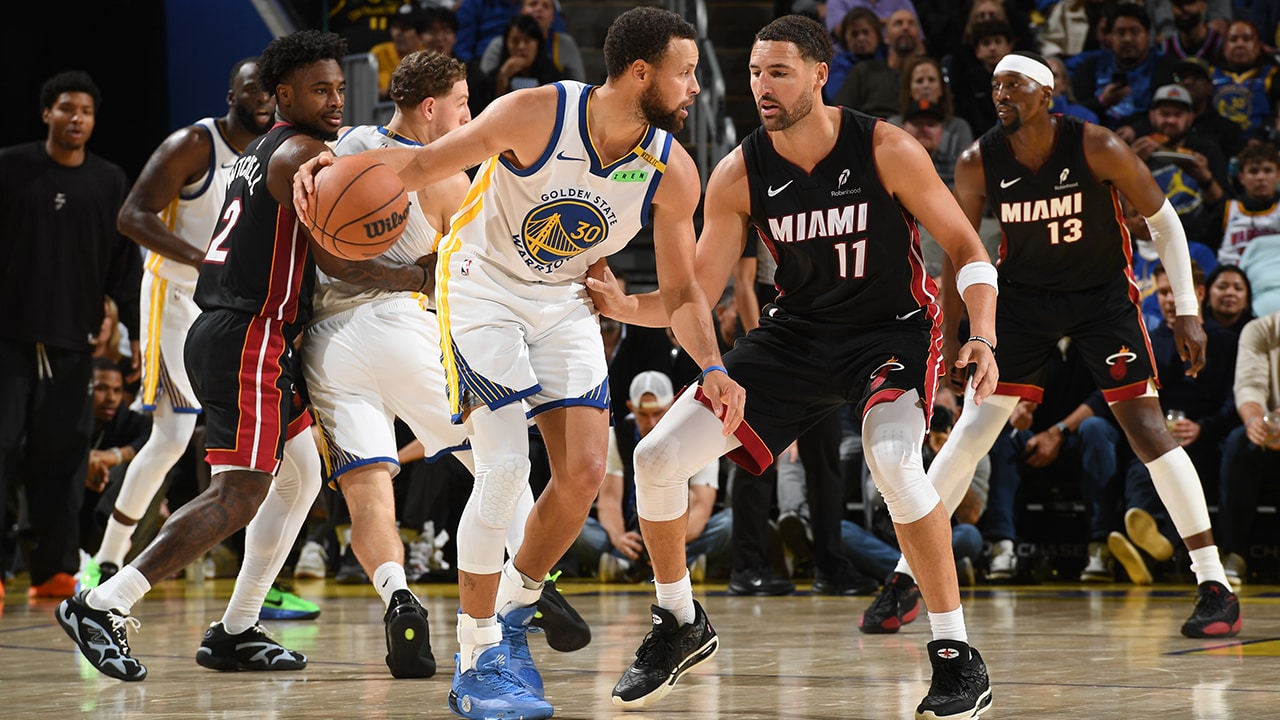

The Golden State Warriors continue to surprise, extending their winning streak to six games with a convincing 120–100 victory over the Miami Heat on Pride Night at Chase Center.
But the final score doesn't tell the entire story.
Miami played Golden State evenly through the first half, entering halftime tied. What began as a competitive contest turned into a comfortable Warriors victory as Golden State increased its defensive intensity and took advantage of its depth after intermission.
For Miami, the loss raises more questions about a talented roster still struggling to develop consistent chemistry.
Golden State's Bench Changes the Game
The Warriors received 53 points from their bench, providing the offensive support necessary to pull away in the second half.
Stephen Curry led Golden State with 29 points, including six three-pointers, but the Warriors didn't depend entirely on their superstar.
Golden State's supporting cast continued to contribute, with rookie Yaxel Lendeborg recording 17 points, eight rebounds, six assists and three steals.
Draymond Green added 11 assists, helping the Warriors finish with 36 assists as a team.
Golden State shot 53 percent from the field and 39 percent from three-point range.
The Warriors also outscored Miami 21–7 in fast-break points.
That combination of efficient shooting, transition offense and bench production proved too much for the Heat.
A Tale of Two Halves
Miami demonstrated that it could compete with Golden State during the opening two quarters.
The teams entered halftime tied, with neither establishing control.
But Golden State gradually took command after the break.
The Warriors increased their defensive pressure, created better offensive opportunities and used their depth to maintain energy throughout the second half.
That ability to make adjustments is becoming an important part of Golden State's early-season identity.
The Warriors aren't simply relying on Curry's shooting. They're finding different ways to win basketball games.
Miami's Chemistry Remains a Concern
The Heat have assembled an intriguing roster featuring Giannis Antetokounmpo, Bam Adebayo, Klay Thompson, Andrew Wiggins and Davion Mitchell.
Yet the offensive chemistry remains inconsistent.
Mitchell led Miami with 22 points and eight assists, including an aggressive fourth-quarter offensive effort.
Antetokounmpo finished with 20 points and 14 rebounds, while Adebayo contributed 18 points and 10 rebounds.
Wiggins added 21 points, and Thompson finished with 11.
Despite those individual contributions, Miami struggled to maintain offensive efficiency.
The Heat shot 41 percent from the field, 30 percent from three-point range and committed 19 turnovers.
More concerning was Golden State's 50–32 advantage in points in the paint.
With Giannis and Adebayo anchoring Miami's frontcourt, the Heat should be capable of providing stronger resistance around the basket.
The challenge for Miami is finding an offensive structure that maximizes each player's strengths without sacrificing spacing or ball movement.
Thompson remains a dangerous perimeter shooter, but Miami must create consistent opportunities for him while allowing Giannis and Adebayo to operate effectively inside.
The Heat have talent. What they haven't consistently demonstrated is how that talent fits together.
S³ Final Analysis
Golden State's sixth consecutive victory provides further evidence that the Warriors are developing into a cohesive team.
Their depth, defensive adjustments and balanced offensive production are allowing them to win without requiring Curry to carry the entire scoring burden.
Miami's situation is different.
The Heat have enough individual talent to compete with quality opponents, as demonstrated by their first-half performance.
But competing for two quarters isn't enough.
Miami must improve its offensive organization, defensive consistency and ability to respond when opponents make adjustments.
The season is still young, leaving time for the Heat to develop the chemistry their roster requires.
For now, Golden State is demonstrating something Miami has yet to establish consistently: a team identity built around players understanding and executing their roles.
S³ Final Verdict: Golden State's 53 bench points and second-half defensive performance were decisive in extending its winning streak to six games. Miami's first-half competitiveness showed its potential, but the Heat's inability to sustain that performance exposed continuing chemistry and execution concerns.
S³ SPORTS | Where Intelligence Meets Impact.