
S³ | SWEET SCIENCE SPORTS • NFL GAME CENTER
October 20, 2026 | S³ NFL Postgame Analysis
San Francisco won the game in the first half and spent the second half protecting it.
Washington spent the opening two quarters creating a deficit its late surge could not overcome.
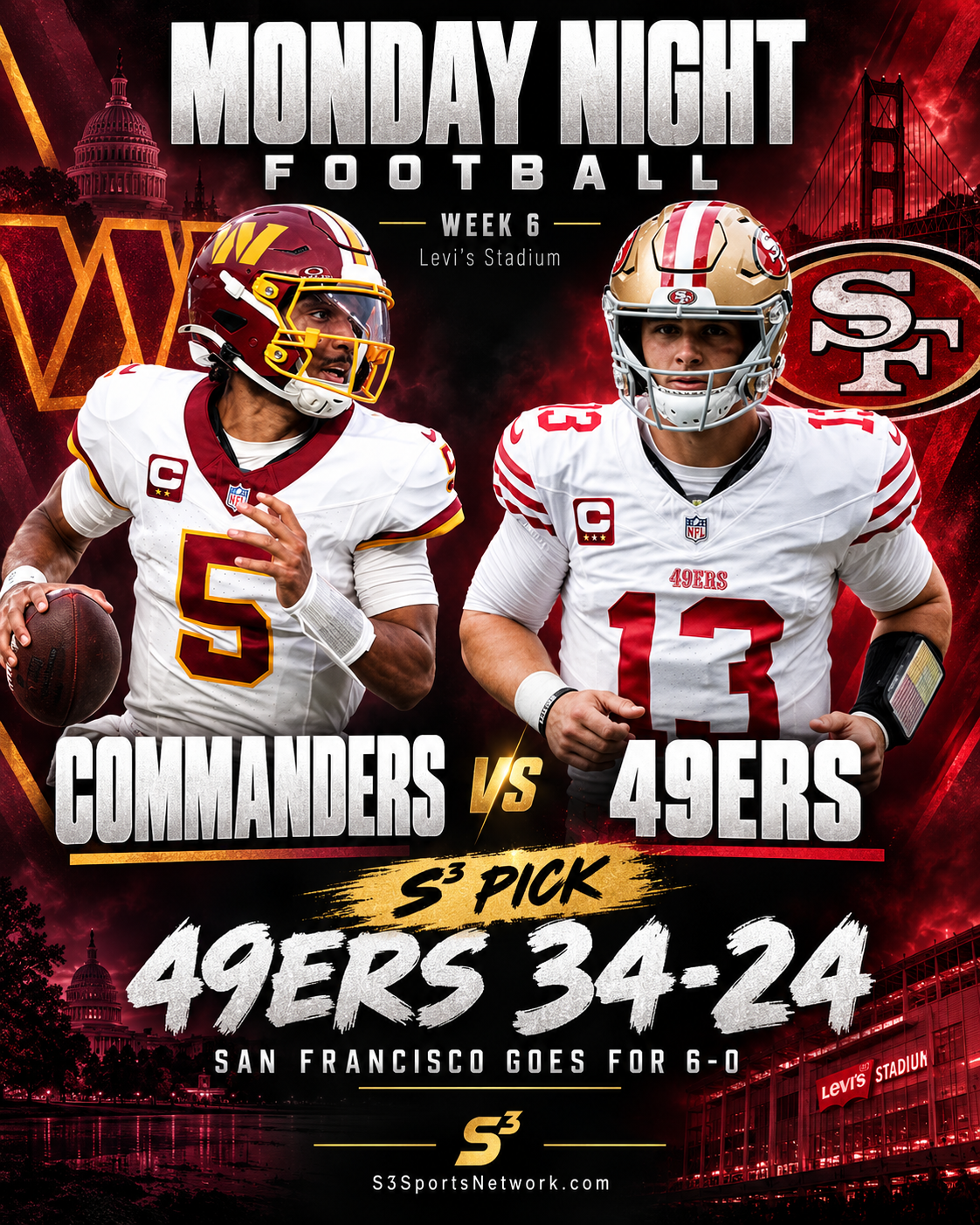
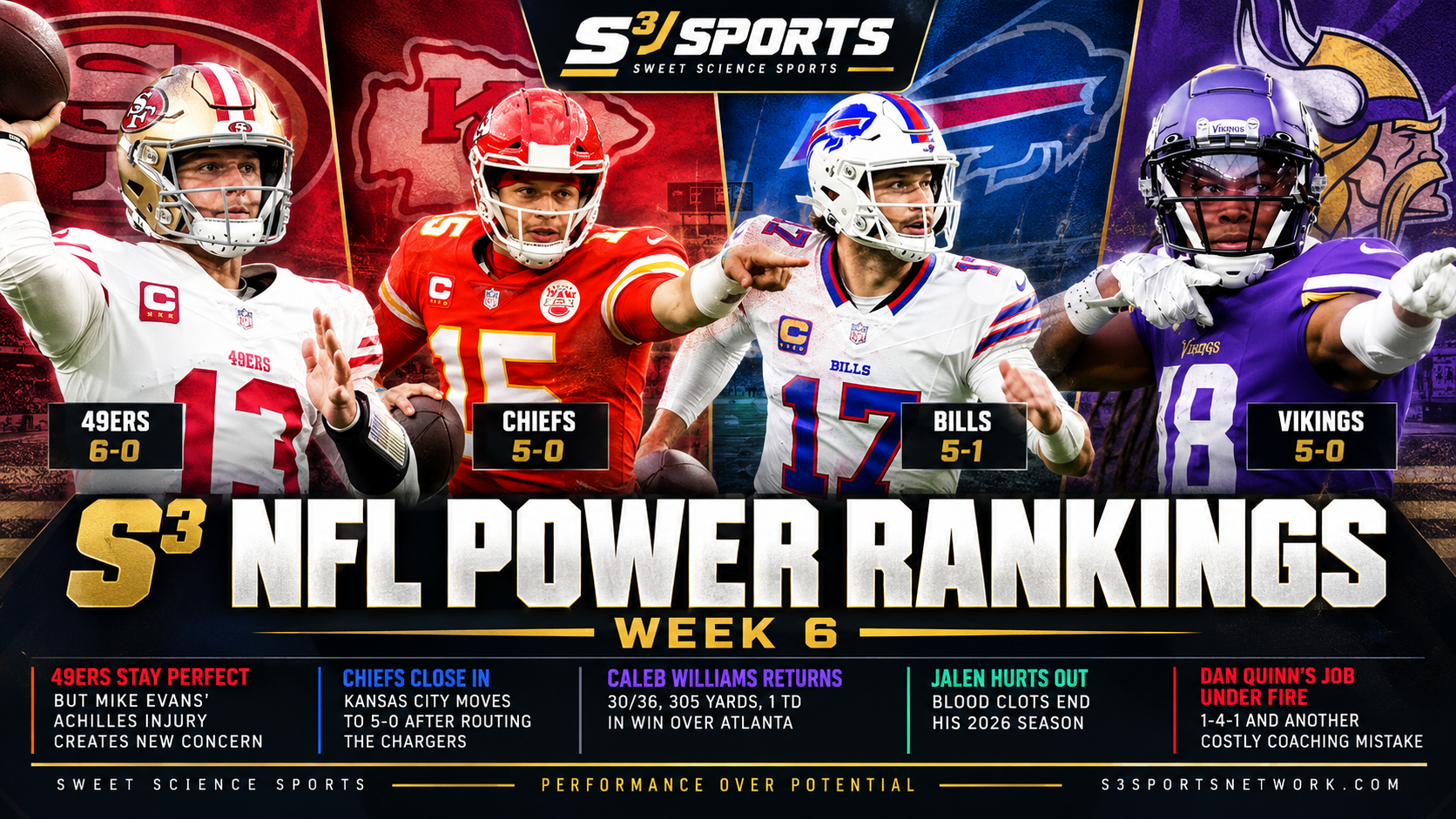
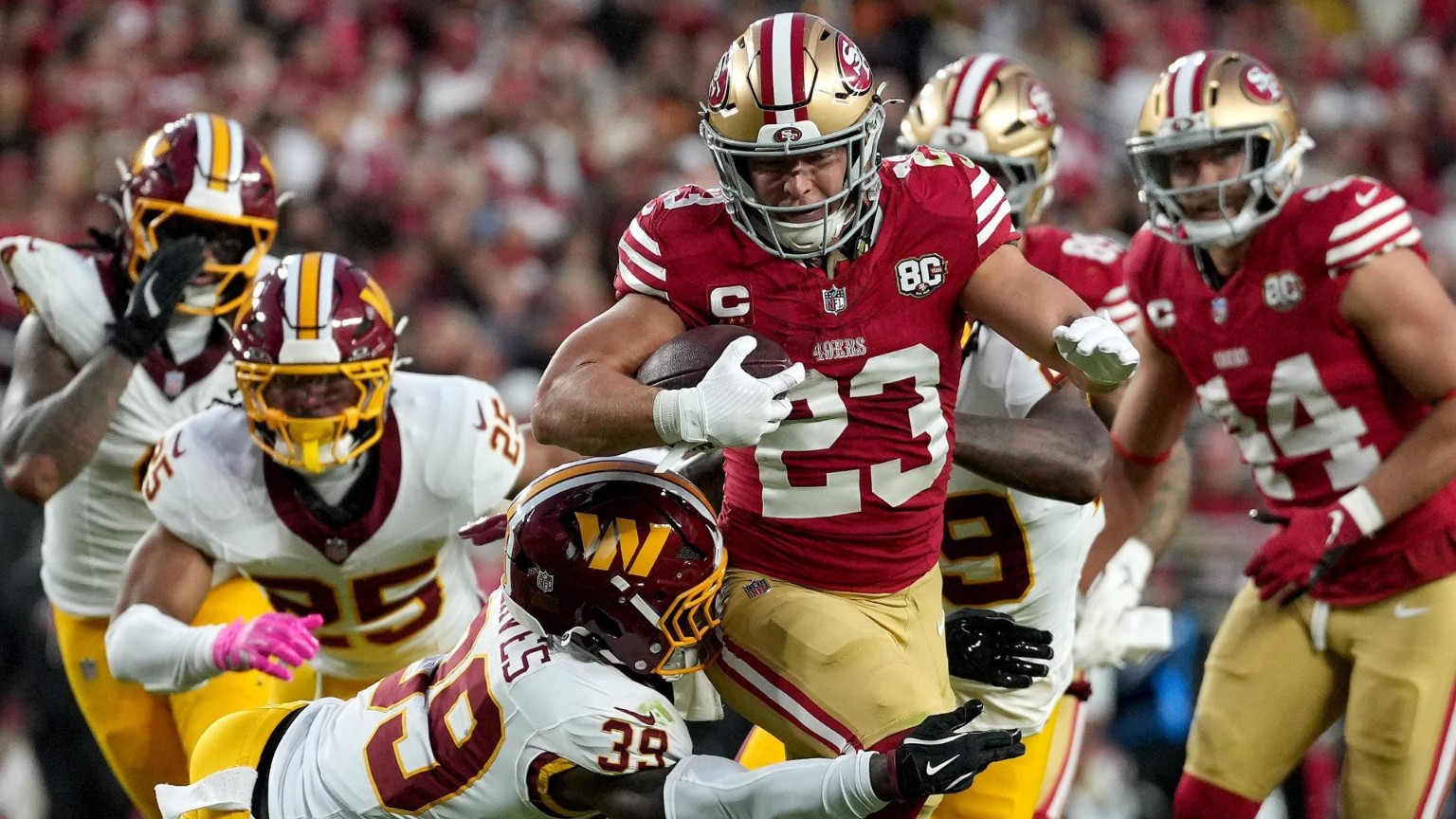
That distinction defined the 49ers’ 23–17 victory over the Commanders. San Francisco established a 20–3 halftime lead, absorbed the loss of Mike Evans, and did enough down the stretch to remain unbeaten at 6–0. Washington fell to 1–4–1, left to evaluate another performance in which its talent was evident but its execution was unreliable.
The Commanders competed. That matters when assessing whether Dan Quinn still has his players’ attention. But effort is not the same as preparation, and a comeback is not a substitute for four quarters of disciplined football.
For Washington, the concern is no longer simply losing games. It is the persistence of mistakes that prevent a talented roster from winning them.
Evans’ Exit Changes the Equation
Before Evans departed with what was described as an aggravated Achilles injury, San Francisco’s passing game consistently put Washington under stress.
Evans caught three passes for 94 yards, providing the downfield production that complemented Christian McCaffrey’s versatility and Brock Purdy’s efficient distribution. His presence forced Washington to account for more than the underneath passing game.
Once he left, the matchup changed.
San Francisco scored only three points after halftime. Washington could devote more attention to McCaffrey and George Kittle without facing the same vertical threat Evans had established early.
That does not make Evans’ absence the sole explanation for the slowdown. A 17-point halftime advantage changes game management, and Washington deserves credit for adjusting. Still, the contrast between the two halves was significant.
San Francisco’s offense went from dictating the terms to struggling to sustain its early production.
For a team with championship ambitions, the immediate question is Evans’ health. The broader question is how effectively Kyle Shanahan can preserve the offense’s spacing and explosiveness if Evans misses time.
Purdy’s Efficiency Gives San Francisco Its Foundation
Purdy completed 21 of 29 passes for 264 yards, one touchdown, and no interceptions, adding 28 yards on the ground.
It was an efficient performance built on the qualities that make him effective in Shanahan’s system: anticipation, accuracy, coverage recognition, and enough movement to extend a possession when the initial structure breaks down.
His mobility does not need to define the offense to influence a game. The ability to escape pressure or collect available rushing yards forces defenses to account for another outcome.
More importantly, Purdy avoided the turnover that could have accelerated Washington’s comeback.
The distinction is worth making: San Francisco did not deliver a complete offensive performance, but its quarterback gave the team a stable platform. The 49ers built a commanding lead without an interception and ultimately protected enough of that advantage to win.
At 6–0, San Francisco has earned its position. Maintaining that standard through injuries will require more consistent production than it generated after halftime.
Sonny Styles Gives Washington a Building Block
Rookie linebacker Sonny Styles finished with 13 tackles, seven solo stops, and a pass defended.
The production reflected his activity, but his appeal extends beyond the tackle total. His range, closing speed, and physicality give Washington a defender capable of influencing plays across the field.
Styles’ pursuit stood out. He covered ground quickly and repeatedly put himself near the football, showing the tools to become a central piece of the defense.
There is an important distinction, nevertheless, between identifying a promising individual performance and evaluating the unit as a whole. Washington still allowed San Francisco to establish a 20–3 lead.
Styles was a positive within that performance, not evidence that the defense had solved its problems.
For the Commanders, the task is to turn promising young players into the foundation of a more dependable team.
Daniels’ Fourth-Down Decision Exposes a Larger Problem
Washington’s most revealing offensive mistake came in the second quarter.
Facing fourth-and-2 at San Francisco’s 13-yard line, Jayden Daniels rolled right and threw the ball out of bounds. An illegal-shift penalty was declined, and the 49ers took possession.
On an earlier down, a throwaway can be the correct decision. On fourth down, it ends the possession without giving the offense a chance to convert.
The available options may have been poor. A receiver may not have separated, and a running lane may not have existed. But the situation demanded an attempt to create a conversion rather than a decision that guaranteed a turnover on downs.
That is an execution failure by the quarterback. It is also a preparation issue the coaching staff must address.
Coming one week after Washington’s overtime clock-management failure against the Giants, the play reinforced a troubling pattern: the Commanders are not consistently handling the situations that decide close games.
Daniels finished with 300 passing yards, two touchdowns, and no interceptions. Those numbers demonstrate his ability to produce. They do not erase the value of a scoring opportunity lost through poor situational judgment.
The next step in his development is not simply generating more offense. It is understanding when a single decision carries more weight than an entire series of productive plays.
McLaurin’s Injury Compounds Washington’s Concerns
Washington also lost Terry McLaurin, who was carted off with a left knee injury after going down while running a route in the first quarter.
He finished with one reception for 27 yards.
The severity of the injury remains uncertain pending further evaluation. Until more information is available, any assessment of his recovery timetable would be premature.
The football implications are clearer. McLaurin is one of Daniels’ most dependable targets, and an extended absence would make an inconsistent passing attack more difficult to stabilize.
Both teams lost an important receiver. The difference was the position each team occupied when it had to adjust.
San Francisco had built a substantial advantage. Washington was trying to erase one.
The Commanders still generated a second-half response, but losing McLaurin reduced their margin for error on a night when that margin was already thin.
Quinn’s Team Is Still Competing. Is It Improving?
Washington’s second-half rally argues against the claim that Quinn has lost the locker room.
A team that cuts a 20–3 deficit to a six-point final margin against an unbeaten opponent has not stopped competing.
But that does not settle the more important question: Is the coaching staff producing measurable improvement?
The Commanders continue to put themselves in difficult positions through uneven starts, missed opportunities, and breakdowns in situational football. When those failures recur, they become more than isolated player mistakes. They become part of the evaluation of the program.
Quinn’s responsibility is not merely to keep Washington competitive. It is to make the team more reliable.
That means preparing Daniels for critical down-and-distance situations, tightening game management, and reducing the avoidable errors that force the Commanders to chase games.
A coaching change deserves discussion when those problems persist. It should not be presented as an automatic solution, particularly with injuries complicating the evaluation. But neither should Washington treat competitive losses as sufficient evidence that the current approach is working.
The S³ assessment: Quinn’s leadership should be judged by whether these recurring failures begin to disappear, not simply by whether his players continue to play hard.
A Vulnerable NFC East Offers Little Consolation
Washington’s record looks worse in the context of a division that has offered repeated opportunities to recover.
The NFC East went a combined 0–6–2 across Weeks 5 and 6, including Washington’s 27–27 tie with the Giants.
Philadelphia lost to Carolina. Dallas fell to Green Bay. New York lost to New Orleans. Washington’s defeat completed another winless week for the division.
That keeps the divisional picture unsettled, but it should not create false confidence.
A weak division can preserve a team’s mathematical opportunity. It cannot correct its execution.
Washington does not need to become a finished product overnight to make progress in this race. It does need to stop surrendering opportunities through mistakes within its control.
S³ Final Analysis: San Francisco Has Adjustments to Make. Washington Has More to Prove.
For San Francisco, this was an imperfect victory with a potentially significant injury attached.
Purdy was efficient. Evans was explosive before his departure. The first-half performance created enough separation to withstand a second-half decline.
The concern is whether that decline exposed a vulnerability opponents can exploit if Evans is unavailable. An unbeaten record does not eliminate the need for adjustment.
Washington’s evaluation is more complicated.
Daniels produced. Styles impressed. The team responded after halftime. Those are legitimate positives.
They also exist alongside another poor start, another costly situational mistake, and another game in which a late rally could not repair earlier failures.
The Commanders have enough individual talent to create competitive stretches. They have not demonstrated the discipline and consistency required to turn those stretches into dependable results.
That is the challenge facing Quinn—and the standard by which Washington should evaluate him.
S³ Bottom Line: San Francisco built the better first half and protected it well enough to stay unbeaten. Washington’s rally showed resilience, but resilience cannot remain the answer to recurring execution failures. Evans’ health is the immediate concern for the 49ers; for the Commanders, McLaurin’s injury adds uncertainty to a team that still needs to prove it is improving under Quinn.
S³ | Sweet Science Sports
Independent Analysis. Beyond the Box Score.