
By Sweet Science Sports
The Rise and Fall of a Franchise on the Brink
The 2005 Cincinnati Bengals season represents one of the most pivotal "what-if" moments in modern NFL history. It was not just a playoff appearance. It was a cultural resurrection.
After more than a decade wandering in irrelevance, Cincinnati finally found its franchise quarterback in Carson Palmer and its stabilizing leadership in Marvin Lewis. The franchise that had once been mocked as the "Bungles" had rediscovered belief.
Then, on the second play of their first playoff game in 15 years, everything changed.
Palmer's torn ACL and MCL didn't just end a season. It fractured a timeline.
At the heart of this chapter is the question that still lingers in Cincinnati: What if Carson Palmer never got hurt?
From Misery to Hope - The Bengals Before 2005
From 1991 through 2003, the Bengals were stuck in a long winter. After their 1991 playoff appearance, the franchise spiraled. The passing of Paul Brown marked the end of an era, and under new leadership, Cincinnati endured a brutal stretch: 55-137 over 13 seasons.
They weren't just losing. They were directionless.
The turning point came in 2003:
- Marvin Lewis was hired to install accountability and structure
- Cincinnati drafted Carson Palmer first overall
- Palmer spent his rookie year learning behind Jon Kitna
That redshirt season proved invaluable. When Palmer took the reins in 2004, the Bengals showed flashes, finishing 8-8 and going 7-4 down the stretch. The foundation was poured. 2005 would be their star rising.
2005 - The Emergence of a Contender
The Bengals opened the season with authority. Their 27-13 win over Cleveland wasn't just a victory - it was a declaration. Cincinnati began 4-0. Then 7-2.
Carson Palmer ascended into the elite tier:
- 3,836 yards
- 32 touchdowns
- 67.8% completion rate
- 101.1 passer rating
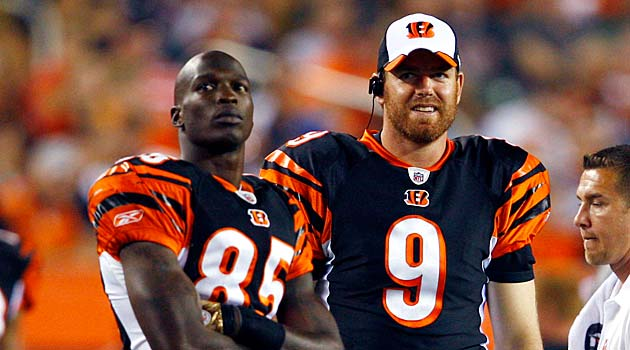
On the perimeter, Chad Johnson was at the peak of his powers. His "Who Covered 85?" jacket became a symbol of dominance. This wasn't reckless offense. It was controlled aggression.
A Week 13 win over Pittsburgh (38-31) confirmed something powerful: Cincinnati wasn't hopeful. They were legitimate.
The Bengals finished 11-5, claimed the AFC North, and sent five players to the Pro Bowl. The window wasn't opening. It was wide open.
The Playoff Moment That Froze Time
Wild Card Round. Bengals vs. Steelers.
Second play of the game. Palmer launches a 66-yard strike to Chris Henry. The stadium explodes. But as the ball travels downfield, Palmer's knee collapses under contact from Kimo von Oelhoffen.
ACL torn. MCL torn. Season altered.
Palmer later said he did not believe the hit was dirty. But legality doesn't soften consequence. Jon Kitna stepped in and fought valiantly. Cincinnati led 17-14 at halftime. But in the second half, Pittsburgh adjusted. The Bengals' momentum evaporated. Final score: 31-17.
The Steelers would go on to win Super Bowl XL. And the Bengals' dynasty window slammed shut before it ever fully opened.
The Aftermath - Momentum Lost
Palmer returned in 2006. The Bengals started 3-0, including a win in Pittsburgh. But something had shifted. The rhythm wasn't the same. Cincinnati finished 8-8.
They would capture the division again in 2009, but that run leaned on defense and the ground game - not the explosive aerial attack that made 2005 special. Frustration mounted. After the 2010 season, Palmer requested a trade. In 2011, he was sent to Oakland. The era ended not with a parade, but with an exit.
The Great "What If" - Rewriting the AFC
If Palmer stays healthy:
- Cincinnati likely defeats Pittsburgh
- They face Denver in the Divisional Round
- An AFC Championship against Indianapolis becomes realistic
- Super Bowl XL against Seattle becomes plausible
The Bengals' offense ranked top five. Their confidence was peaking. Their quarterback was entering his prime. A Super Bowl win would have elevated Marvin Lewis into elite coaching status, changed Carson Palmer's legacy permanently, possibly prevented Bill Cowher's championship run, and altered future draft paths - including Andy Dalton's eventual arrival.
One healthy knee could have reshaped an entire decade of AFC history.
Conclusion: Fragility Defines Football
The 2005 Bengals remind us of something brutal and true: Dynasties are not only built on talent. They are preserved by health.
Cincinnati had the quarterback. They had the receiver. They had the culture shift. They lacked one thing at the worst possible moment - continuity.
The story of the 2005 Bengals is not about failure. It is about interruption. And in the NFL, interruption is often the difference between "contender" and "champion."
Sweet Science Sports - Where Intelligence Meets Impact