
S³ COLLEGE BASKETBALL
College basketball has long celebrated itself as one of the most unpredictable sports in America. Every March, the NCAA Tournament delivers unforgettable upsets, Cinderella stories, and moments that remind fans why the sport remains so compelling.
But beneath the excitement of March Madness, something else is happening.
College basketball's competitive landscape is becoming increasingly concentrated among a handful of powerful conferences.
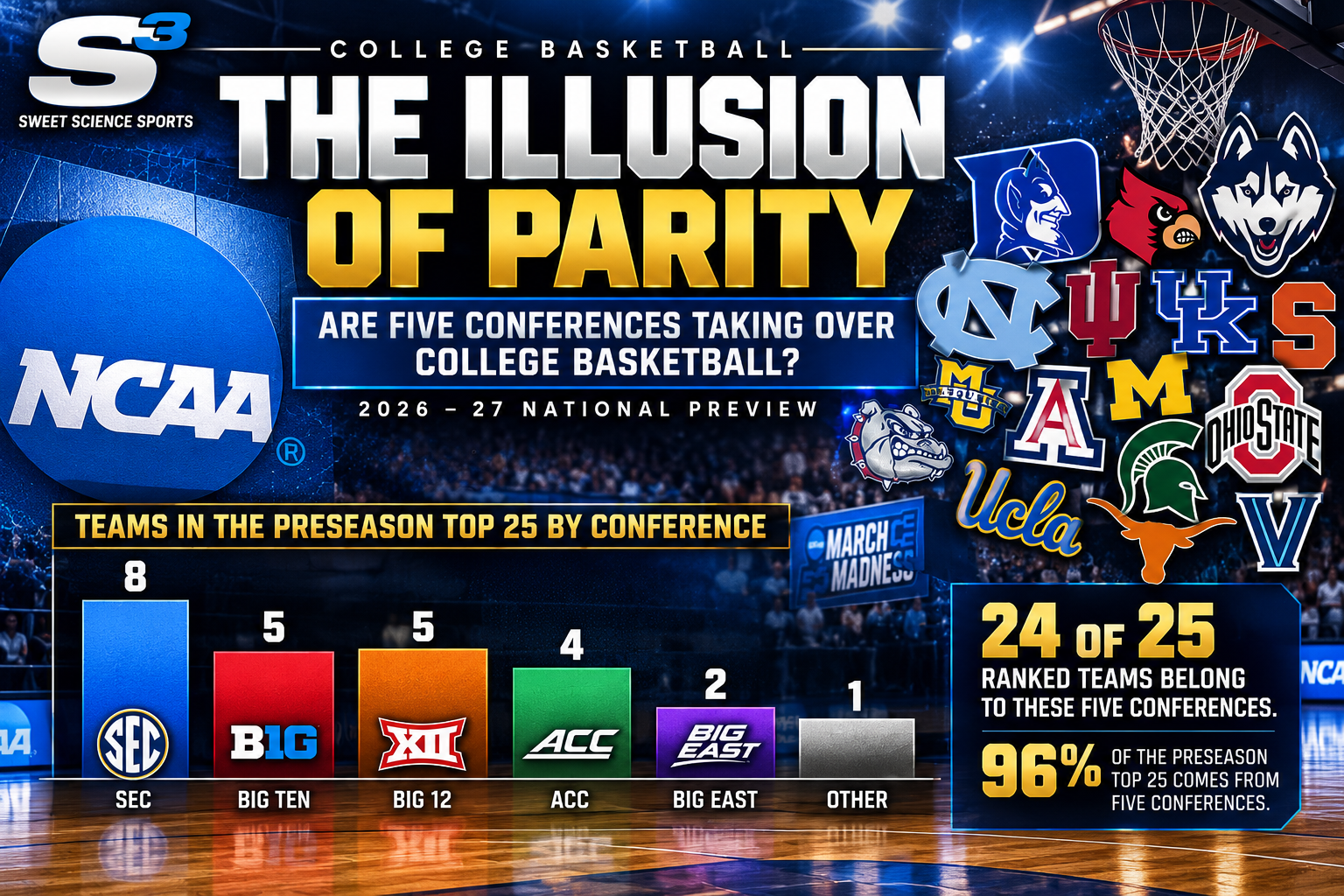
According to The Assist's 2026–27 preseason Top 25, an astonishing 24 of the nation's 25 ranked teams belong to just five conferences.
That's 96 percent.
The SEC leads with eight ranked programs, followed by the Big Ten and Big 12 with five apiece, the ACC with four, and the Big East with two.
Only one ranked team comes from outside those five conferences.
That raises an uncomfortable question.
Where is the parity in college basketball?
The Power Conferences Are Consolidating Talent
College basketball has never been a completely level playing field.
Traditional powers such as Duke, Kentucky, Kansas, North Carolina, and UCLA have historically enjoyed advantages in recruiting, national exposure, and financial resources.
Nevertheless, the current environment has introduced new mechanisms that could make those advantages even greater.
The transfer portal, name, image, and likeness compensation, revenue sharing, and conference realignment have fundamentally changed how college basketball programs operate.
Today, a successful mid-major player can attract interest from major programs offering greater financial opportunities and national exposure.
That creates a difficult situation for smaller schools.
They can recruit talented players, develop those players, and build successful programs. But retaining that talent has become increasingly challenging.
Meanwhile, wealthy programs can address roster weaknesses almost immediately by acquiring established college players.
The result is a system that increasingly rewards financial resources and talent acquisition.
The SEC Is Making Its Move
The Southeastern Conference enters the 2026–27 season with eight teams in The Assist's preseason Top 25, more than any other conference.
Florida sits atop the rankings, with the Gators receiving unanimous support from the panel.
Florida's advantage is built around continuity, experienced personnel, and a formidable frontcourt.
But the larger story concerns the SEC's depth.
According to the preview, SEC programs acquired ten players who ranked among the nation's top 30 scorers through the transfer portal.
That is an extraordinary concentration of offensive production.
Nevertheless, collecting talented scorers doesn't automatically create championship basketball.
Players must defend, share the basketball, accept different roles, and function within a system.
The SEC may have the strongest collection of talent, but translating that talent into championships will require more than financial investment.
UConn Remains a Championship Threat
While much of the attention surrounds Florida, Duke, and the SEC, Connecticut deserves serious consideration.
Under head coach Dan Hurley, UConn has established a championship identity built around disciplined execution, player development, defensive accountability, and team chemistry.
The Huskies have demonstrated that a program doesn't necessarily need to belong to the SEC, Big Ten, or Big 12 to compete for national championships.
UConn is our early S³ selection to reach the 2027 Final Four.
The Huskies also represent an important distinction in this discussion.
The Big East remains a major basketball conference with substantial tradition and national credibility. Nevertheless, its two representatives in this particular preseason Top 25 suggest a narrower concentration of highly regarded teams than in several competing leagues.
UConn's success demonstrates the importance of coaching and culture, even as financial resources become increasingly influential.
March Madness Still Offers Hope
There is an important difference between parity in the NCAA Tournament and parity throughout college basketball.
In 2018, UMBC became the first No. 16 seed to defeat a No. 1 seed in the men's NCAA Tournament, stunning Virginia 74–54.
Five years later, Fairleigh Dickinson accomplished the same feat by defeating Purdue 63–58.
Those victories demonstrated that smaller programs can compete against established national powers.
But winning one tournament game and building a sustainable national championship contender are different challenges.
The NCAA Tournament's single-elimination format creates opportunities for remarkable upsets.
It does not necessarily mean that financial resources, recruiting opportunities, and roster depth are distributed equally.
March Madness provides opportunity. It doesn't guarantee competitive equality.
The Transfer Portal Has Changed the Development Model
For decades, college basketball programs depended heavily on recruiting and developing players over multiple seasons.
A freshman might spend two years learning a system before becoming a major contributor as a junior or senior.
Today, programs can dramatically reshape their rosters in one offseason.
That flexibility benefits coaches attempting to rebuild quickly, but it also creates uncertainty.
Player movement can disrupt continuity, weaken smaller programs, and force coaching staffs to reconstruct their teams annually.
At the same time, the portal gives athletes opportunities to find better situations, receive compensation, and compete at higher levels.
Both realities deserve acknowledgment.
The issue isn't whether players should have opportunities to transfer.
The question is whether college basketball can preserve a competitive environment in which programs outside the wealthiest conferences have a realistic opportunity to develop and retain championship-level talent.
The Eligibility Crisis Adds Another Layer
College basketball's competitive structure faces another challenge: uncertainty surrounding player eligibility.
Ongoing legal disputes and changing NCAA rules have complicated roster construction.
Programs may enter the season without knowing whether certain players will ultimately be permitted to compete.
That uncertainty affects recruiting, rotations, scholarships, and long-term planning.
It also raises questions about competitive consistency.
A national competition should operate under clear, predictable eligibility standards.
When roster availability can depend on legal rulings, evaluating teams becomes considerably more difficult.
S³ Early Final Four Predictions
With the season approaching, Sweet Science Sports identifies four programs capable of making a serious national championship run.
Florida: The preseason favorite, supported by continuity, frontcourt strength, and experienced personnel.
Duke: A talented, versatile roster with the potential to develop into the nation's most complete team.
UConn: A championship-tested program with the coaching culture and tactical discipline to compete with anyone.
Michigan State: An experienced program led by Tom Izzo, with Jeremy Fears Jr. providing the type of high-level point guard play that can become invaluable in March.
Arizona, Illinois, and Houston remain serious threats capable of disrupting those projections.
These are early selections, subject to adjustment as teams establish their identities during the regular season.
Final Word: Is College Basketball Losing Its Competitive Balance?
College basketball isn't lacking talented players or compelling programs.
The sport remains filled with exceptional athletes, outstanding coaches, and passionate fan bases.
But talent is becoming increasingly concentrated.
When 96 percent of a preseason Top 25 comes from five conferences, it deserves examination.
Conference realignment has contributed to that concentration, and preseason rankings are not definitive proof of competitive imbalance. Nevertheless, the distribution raises legitimate questions about the sport's direction.
The NCAA Tournament will continue producing memorable upsets.
Smaller programs will continue developing talented players.
And every March, fans will continue believing their school has a chance to make history.
But the bigger question is whether those programs will have the resources and roster stability to build something sustainable.
College basketball doesn't need every program to be equally successful. It needs a competitive structure where success isn't increasingly determined by conference affiliation and financial resources.
Because if five conferences control nearly all the preseason attention, recruiting advantages, and financial opportunities, the sport risks becoming less about who can build the best basketball program and more about who can afford to assemble the best roster.
And that's a different game altogether.