
S³ Opinion | October 8, 2026
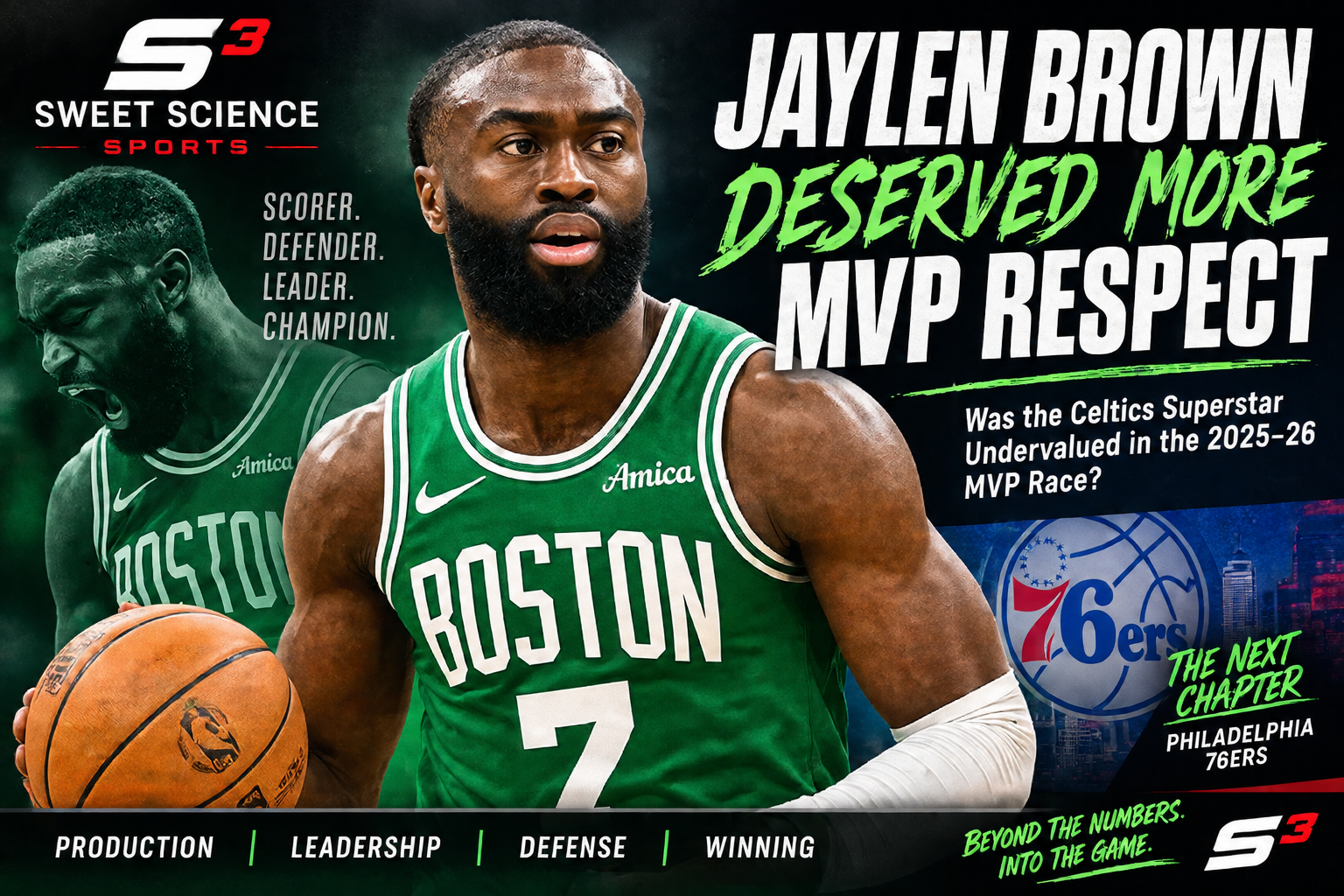
Jaylen Brown didn't need to win the 2025–26 NBA Most Valuable Player award to receive the recognition his season deserved.
But finishing sixth in MVP voting, with just 89 voting points, raises a legitimate question: Did NBA voters fully appreciate what Brown accomplished in Boston?
This isn't an argument that Brown should have finished ahead of Shai Gilgeous-Alexander or Nikola Jokić. Both delivered extraordinary seasons.
It's an argument that Brown's production, leadership, defensive responsibilities and the circumstances surrounding Boston's success deserved considerably more consideration.
Boston Was Supposed to Take a Step Back
The Celtics entered the 2025–26 season facing considerable uncertainty.
Jayson Tatum missed significant time, while the departures of Jrue Holiday and Kristaps Porziņģis changed the team's foundation.
Boston was no longer operating with the same championship roster that had dominated the Eastern Conference.
Yet the Celtics finished 56–26, securing the second seed in the East.
And Brown was at the center of that success.
He averaged career highs of 28.7 points and 5.1 assists, along with 6.9 rebounds, while appearing in 71 games.
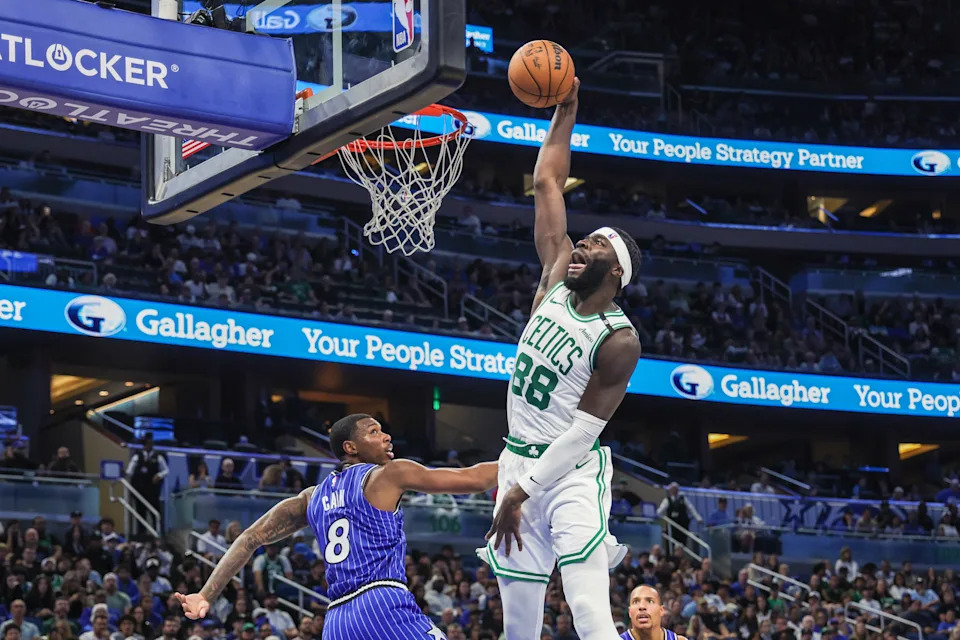
Brown wasn't simply filling the scoring void left by Tatum. He was assuming greater responsibility as Boston's primary offensive option while maintaining significant defensive duties.
That's the kind of season that should command serious MVP consideration.
The MVP Voting Gap
The final results tell an interesting story.
| Player | Finish | Voting points |
|---|---|---|
| Shai Gilgeous-Alexander | 1st | 939 |
| Nikola Jokić | 2nd | 634 |
| Victor Wembanyama | 3rd | 569 |
| Luka Dončić | 4th | 250 |
| Cade Cunningham | 5th | 117 |
| Jaylen Brown | 6th | 89 |
Brown wasn't particularly close to the top three in voting points.
But should the difference have been that substantial?
Gilgeous-Alexander averaged 31.1 points while leading Oklahoma City to 64 victories. Jokić produced another remarkable season, averaging 27.7 points, 12.9 rebounds and 10.7 assists.
Their MVP credentials were undeniable.
Nevertheless, Brown's case deserves consideration beyond a direct statistical comparison.
Boston won 56 games despite losing important contributors and playing much of the season without its other franchise superstar.
Shouldn't overcoming those circumstances count for something?
Brown did receive meaningful recognition elsewhere: he earned All-NBA Second Team honors, receiving 44 First Team votes and narrowly missing a place on the First Team. That distinction matters. The S³ argument is not that his season went unrecognized, but that his MVP voting total understated its value.
What If Nikola Jokić Had Lost His Second-Best Player?
Consider a hypothetical situation.
Imagine Denver losing its second-best player for most of an entire season.
Now imagine Jokić responding by producing career-best scoring numbers, carrying greater offensive responsibility and leading the Nuggets to 56 victories.
Would that achievement become a central storyline in the MVP conversation?
In S³'s view, it likely would, given Jokić's established reputation and the extraordinary standard he has set. This is a hypothetical comparison, not evidence of how individual voters made their decisions.
That doesn't mean Jokić receives undeserved recognition. His accomplishments have earned him that reputation.
But it raises a question about consistency.
Are MVP voters evaluating what players accomplish under difficult circumstances, or can an established superstar reputation influence how those accomplishments are interpreted?
Brown deserves to be evaluated by the same standard.
The Defensive Factor: Why Doesn't Brown Get More Credit?
In S³'s assessment, this is one of the most overlooked parts of Brown's MVP case.
We regard Brown as a high-level perimeter defender capable of guarding multiple positions and taking difficult assignments against opposing scorers.
That defensive responsibility didn't disappear when his offensive workload increased.
Compare that with several players who finished ahead of him. The following comparisons reflect S³'s basketball evaluation, not an official defensive ranking.
Luka Dončić is an extraordinary offensive talent, but S³ views his defensive limitations as an important consideration when assessing his complete game.
Jokić possesses outstanding basketball intelligence, positioning and defensive rebounding ability. In our assessment, his mobility and traditional rim-protection limitations can nevertheless create vulnerabilities.
Gilgeous-Alexander contributes defensively, although his role differs from Brown's perimeter assignments. Different responsibilities make a direct comparison imperfect.
Cade Cunningham is a capable defender whose size creates advantages, but S³ favors Brown's versatility as an individual perimeter defender.
Victor Wembanyama is the obvious exception to our argument. His defensive impact is extraordinary and fundamentally changes how opponents attack the basket.
And that brings us to an important question.
If Wembanyama's defense can substantially strengthen his MVP candidacy, shouldn't Brown's defensive contributions receive meaningful consideration as well?
The two players defend differently, and this is not a claim that their defensive impact is equivalent. Defense should nevertheless remain an important part of evaluating a player's complete performance.
Brown did not receive an All-Defensive Team selection, although he received seven voting points.
For a player who carried significant responsibilities on both ends of the court, S³ believes that omission deserves scrutiny.
Three Seasons of Brown Making His Case
Brown's 2025–26 performance wasn't an isolated accomplishment.
During Boston's 2024 championship run, Brown captured both the Eastern Conference Finals MVP and NBA Finals MVP awards.
Those performances demonstrated his ability to deliver under championship pressure.
Looking at the last three seasons, S³ believes there is a legitimate argument that Brown has been Boston's most important player when postseason performances, two-way contributions and leadership are emphasized.
Tatum has his own compelling case based on sustained production and all-around impact.
But Brown's accomplishments should stand on their own.
His success shouldn't constantly be measured through his relationship with Tatum.
Did the Celtics Undervalue Brown, Too?
Boston's decision to trade Brown to the Philadelphia 76ers in July 2026 added another layer to the discussion.
The deal became official on July 6, sending Brown to Philadelphia in exchange for Paul George, two first-round picks and two second-round picks.
After Brown helped guide the Celtics through an unexpectedly successful season, the franchise moved him as part of a major roster restructuring.
Boston's leadership cited salary-cap considerations and future flexibility in explaining the decision. Those considerations do not, by themselves, establish that the franchise undervalued Brown.
Still, the timing was remarkable.
Brown had just demonstrated his ability to lead a contender without Tatum for much of the season.
Now Philadelphia has an opportunity to see what Brown can accomplish in a different environment.
His next chapter could significantly influence how his Boston legacy is remembered.
S³ Final Word: Recognition Matters
Shai Gilgeous-Alexander deserved serious consideration for MVP.
Nikola Jokić deserved serious consideration.
Victor Wembanyama's defensive dominance and two-way production also made him a legitimate candidate.
But recognizing those players shouldn't diminish what Jaylen Brown accomplished.
He averaged nearly 29 points per game, helped lead Boston to 56 victories, carried substantial defensive responsibilities and kept the Celtics among the Eastern Conference's elite despite major adversity.
Brown didn't have to win the MVP award. He didn't even have to finish second.
His All-NBA Second Team selection acknowledged an outstanding season. In S³'s view, nevertheless, his performance warranted a stronger presence on MVP ballots than the final voting totals suggest.
The NBA celebrates scoring, playmaking, efficiency and winning. It should also consistently recognize defense, leadership, availability and the ability to overcome adversity.
Jaylen Brown delivered across those categories.
S³ Verdict: Jaylen Brown wasn't necessarily robbed of the MVP award. But there's a compelling argument that he was robbed of the level of MVP recognition his season deserved.
Sweet Science Sports (S³) | Beyond the Numbers. Into the Game.